
A New Innovation Campus in South-West Berlin – Where Knowledge Is Turned Into Business
FUBIC creates space for technology-focused companies
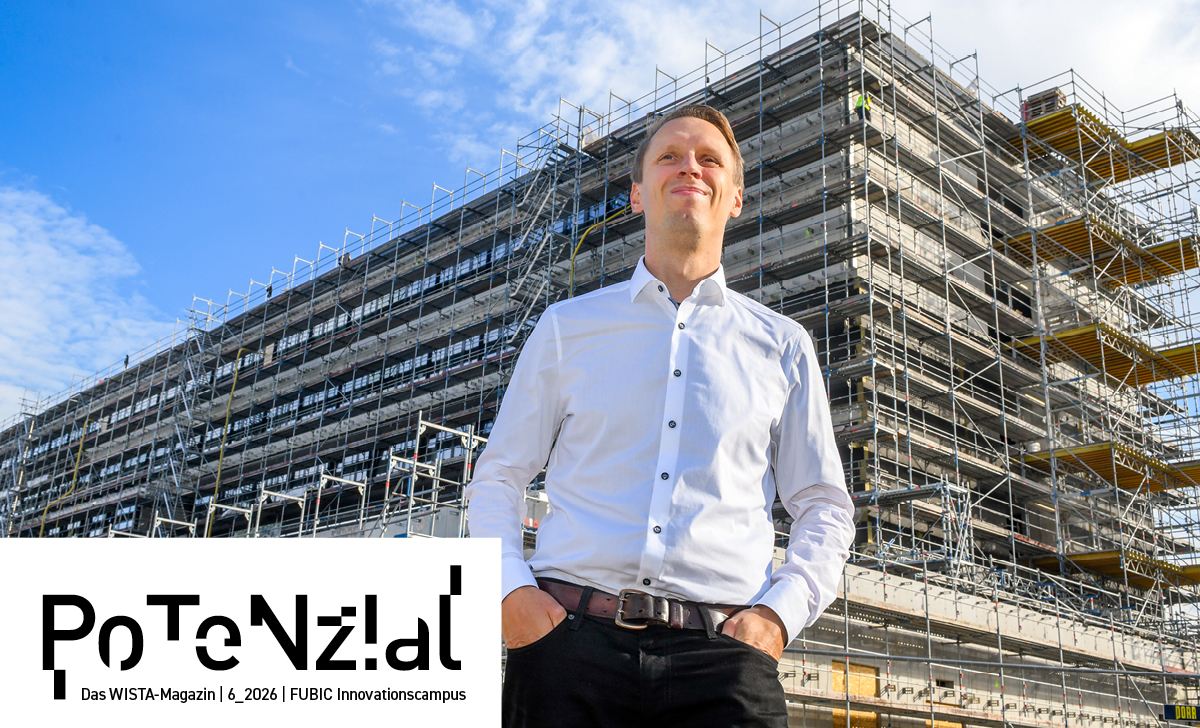
Drilling, cabling and plastering are all well underway at FUBIC (Business and Innovation Center next to Freie Universität Berlin Campus). The former US military hospital on Fabeckstraße is being transformed into a new innovation campus in Berlin’s Southwestern innovation region.
Julian Kahl is not particularly concerned about the builders leaving. What interests him is how scientific discoveries can be turned into successful businesses and how those businesses grow. Since March 2026, he has been heading the start-up and technology centre in Berlin’s south-west for WISTA Management GmbH. In the years to come, the centre will provide a home for up to 80 technology-focused start-ups and young companies, with the potential to create as many as 1,000 jobs. FUBIC is to be the solution to a problem that particular location has known for years: Dahlem has an exceptionally high concentration of research institutions, but, until now, there has been relatively little space for companies emerging from that research to establish themselves and grow.
The area’s scientific tradition stretches back more than a century. The first institutes of the Kaiser Wilhelm Society were established here in 1912, which later became the Max Planck Institutes. After the war, Freie Universität Berlin was founded. Today, Freie Universität, the Max Planck Institutes, the Zuse Institute, facilities of the Federal Institute for Materials Research and Testing (BAM) and Charité – Universitätsmedizin Berlin’s Campus Benjamin Franklin are all located in close proximity.
There has never been any shortage of research here. “What has been missing until now,” says Kahl, “is a place where young companies can stay and continue to grow after their initial development phase. We want to close that gap.”
The idea of establishing a start-up and technology centre in southwest Berlin first emerged more than a decade ago. Important steps towards making the project a reality followed in the years thereafter, including an urban development agreement, a development plan and the allocation of funding. The former American hospital, which was used by Charité, among others, after the Allied forces withdrew and later stood largely empty, was to become the centrepiece of a new technology-driven district.
“Research-intensive start-ups in life sciences and deep tech often face the challenge of finding laboratory and office space that is both suitable for their needs and affordable as they expand,” says Kahl. FUBIC is intended to provide the necessary conditions, helping technology-focused start-ups establish themselves at the location and grow over the long term.
The centre is aimed in particular at start-ups and young companies emerging from local research institutions in the fields of life sciences, healthcare and information and communication technologies. FUBIC will provide infrastructure tailored to their needs, including laboratory and office space, co-working areas, shared facilities and complementary support services.
The innovation campus is also intended to act as a catalyst for Berlin SÜDWEST, one of WISTA’s so-called Zukunftsorte, places generating future innovation. The aim is to bring research, entrepreneurship, and industry closer together, clustered around the area's scientific institutions.
Fostering links between the different industry sectors represented on campus is also important to Kahl. He sees considerable potential for innovation, for example, at the intersection of biotechnology, data science and automated laboratory processes, where specialised infrastructure and digital technologies can support the development of new therapies, diagnostic methods, and industrial applications.
“These connections cannot be established top-down. But we can create an environment that removes barriers to starting a business, encourages exchange between different disciplines, and supports young companies as they grow,” he adds.
The emerging campus is also home to FUHUB, which took up operations in 2025. Kahl does not see it as a competitor. The publicly funded FUBIC and the privately developed FUHUB premises are aimed at different target groups and are intended to complement one another—for example, through the Scale-up Lab run by FUB Innovation GmbH.
Kahl has spent more than ten years working to support academic spin-offs and promote technology transfer, including at Fraunhofer-Gesellschaft and the German Academy of Science and Engineering. Even before the centre opens, his main priority is bringing the right people and organisations together. By building strategic partnerships and attracting the first anchor tenants, he hopes to create an ecosystem that makes it easier for technology-focused start-ups to access laboratory infrastructure, talent, capital and cooperation partners.
Pre-leasing is already underway. “In addition to the considerable start-up potential in south-west Berlin, FUBIC is deliberately targeting technology-focused companies across Germany, as well as international start-ups looking to establish a foothold in Berlin’s innovation ecosystem,” Kahl adds.
Rico Bigelmann for Potenzial
FUBIC Innovation Campus – The Full Service Agency for Start-ups in Berlin SÜDWEST