
Smart monitoring of concrete bridges
Spree Monitoring aims to monitor bridges continuously and cost-effectively, detecting damage at an early stage
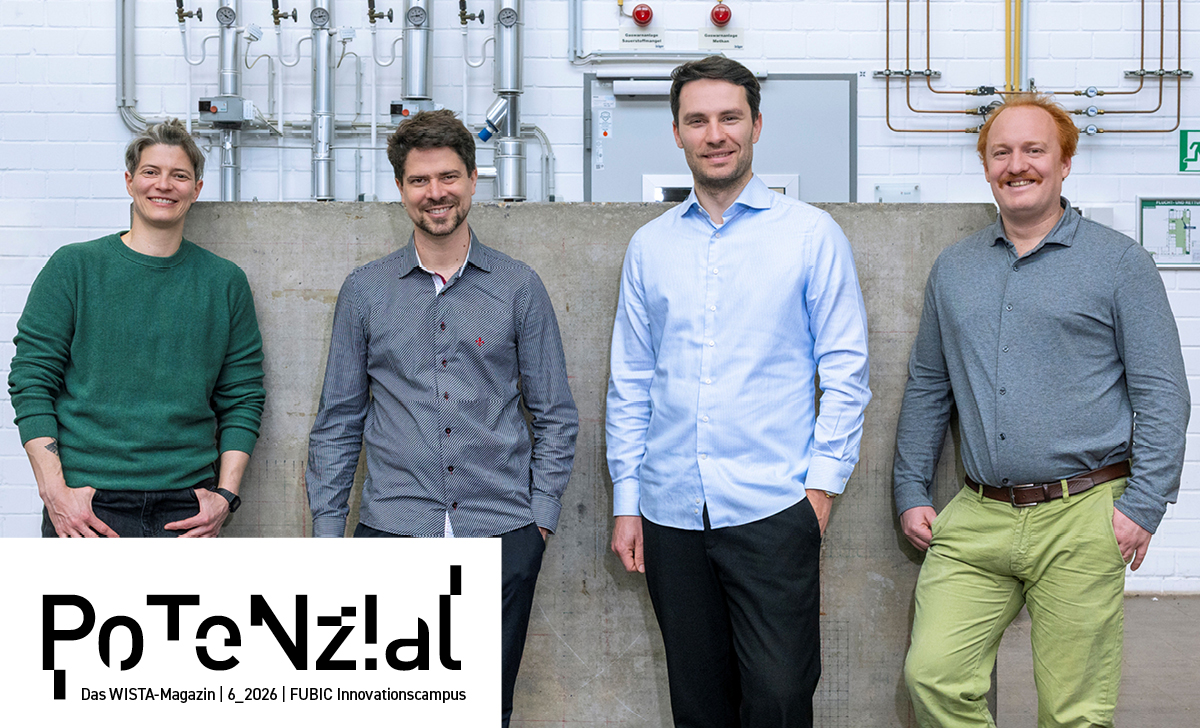
Deteriorating infrastructure is a recurring topic in the German media, particularly when bridges have to be closed at short notice because cracks have appeared. Sometimes they even collapse altogether, as the Carola Bridge did in Dresden in 2024. The main construction material in that case was concrete—and concrete is precisely what the team at Spree Monitoring GmbH is concerned with.
A spin-off of the Federal Institute for Materials Research and Testing (BAM), the start-up aims to collect measurement data from throughout the entire volume of concrete, allowing it to get a better read on the material. Or to put it more aptly: to get a better listen. Spree Monitoring, currently based at BAM’s historic premises in the Berlin SÜDWEST innovation region, has developed a specialised ultrasound technique. “Concrete consists of several components, including cement and aggregate, making it a highly heterogeneous material. Our method does not simply measure how long an ultrasonic wave takes to travel directly through the material,” explains CEO Niklas Epple. “We also analyse all the reflections within it. This means the ultrasonic waves travel through the structure for longer, enabling us to detect changes at an early stage.”
Of course, bridges and other major infrastructure assets are inspected regularly. But monitoring techniques are often deployed only when a specific problem arises, rather than as a preventive measure. Many structures undergo a mandatory visual inspection only once every three to six years. Spree Monitoring aims to close this gap.
Its approach is to equip bridges with sensors that continuously collect data. “We gather huge amounts of data in every part of the world, yet we are lagging behind when it comes to this critical part of our infrastructure,” says Epple. “Our method is highly sensitive, but still affordable enough to be installed in a wide range of structures. We offer an end-to-end solution covering everything from installation and measurement systems to data analysis.”
Once FUBIC (Business and Innovation Center next to Freie Universität Berlin Campus) is completed, Spree Monitoring plans to move in. Conveniently, the new centre is just around the corner from BAM “That’s a real advantage for us, as we want to maintain our links with BAM,” says Epple, who studied geophysics and seismology.
“The new technology campus will provide modern laboratories and offices that are ideally suited to our work. We will continue to carry out research to improve our methods, while also looking to grow the business. The space at FUBIC can be expanded flexibly as our needs change. The co-working spaces will also come in handy if we want to offer internships at short notice. It’s an ideal set-up for us.”
Spree Monitoring is currently running several pilot projects in Germany and looking for customers. The potential market seems vast: Many of the country’s bridges are approaching the end of their service life, yet cannot simply be replaced overnight. This makes it all the more important for those responsible for maintaining them to keep a close eye on their condition. “Our monitoring technique allows us to track changes in the actual condition of bridges continuously over time. Among other things, this helps us determine whether their structural performance still matches the assumptions and calculations on which they were designed—and, above all, whether they continue to meet current requirements,” explains co-founder Julia Hau. “With this information, we can help ensure that bridges remain in service for longer and can continue to be operated safely.”
Klaus Atangana-Rathje for Potenzial
Spree Monitoring: Bridge Monitoring with Coda Wave Interferometry