
Magnetic field during catalyst synthesis triples ammonia yield
Team at HZB demonstrates a scalable strategy for developing next-generation electrocatalysts for efficient and sustainable chemical production
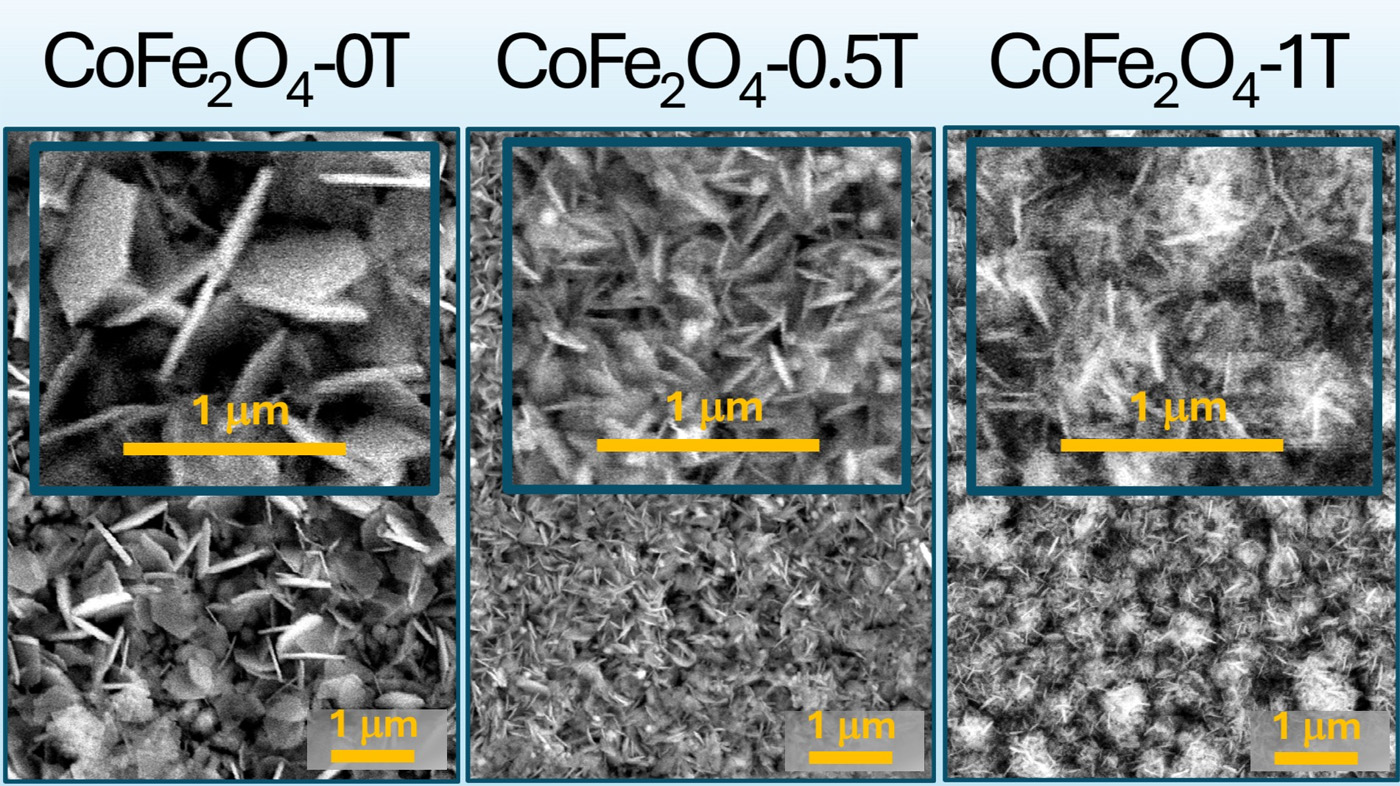
Applying an external magnetic field during the synthesis of CoFe₂O₄ electrocatalysts triples the ammonia yield during electrocatalytic conversion. The magnetic field alters the surface states of the spinel oxide thin films, making catalytically active sites more accessible. In the journal ‘Advanced Functional Materials’, a team led by Marcel Risch at HZB and Sanjay Mathur at University of Cologne demonstrates a scalable strategy for developing next-generation electrocatalysts for efficient and sustainable chemical production.
From the chemical industry and the hydrogen economy to the production of ammonia-based fertilisers, new catalyst technologies hold the key to greater sustainability and efficiency. Take ammonia synthesis, for example: the well-known Haber-Bosch process consumes between 1 and 2 per cent of the world’s energy and is responsible for almost 1 per cent of annual greenhouse gas emissions. However, the energy-intensive Haber-Bosch process is no longer the only option. A newer approach is based on the electrochemical conversion of nitrate into ammonia. Nitrate accumulates in vast quantities as slurry in intensive agriculture and is particularly harmful to waterways. However, suitable catalysts are needed to suppress the formation of hydrogen and nitrogen-containing by-products during the conversion of nitrate to ammonia. In this regard, the class of spinel transition metal oxides is considered particularly promising in this regard, especially thin films of CoFe₂O₄.
An external magnetic field applied during the synthesis of these catalysts can enormously increase their efficiency and selectivity, as demonstrated by a study led by Dr Marcel Risch, HZB, and Prof. Dr Sanjay Mathur, University of Cologne. ‘By applying a magnetic field during chemical vapour deposition, we aimed to tailor the surface states and cation distribution in CoFe₂O₄ thin films to create more efficient surface-engineered electrocatalysts,” says Mathur, who led the synthesis of the materials. This assumption was confirmed very clearly.
The CoFe₂O₄ layers produced under 1 T magnetic field performed best: compared to CoFe₂O₄ produced without a magnetic field, they produced three times more ammonia, demonstrating the effectiveness of magnetic-field-controlled surface engineering. When comparing the ammonia yield of the CoFe₂O₄-1T catalyst with that of pure iron oxide Fe3O4-1T, also synthesised under a magnetic field of 1 Tesla, the ammonia yield was several fold (22 times) higher. This shows that cobalt plays a decisive role in nitrate reduction. Supplementary DFT calculations confirm that cobalt does indeed suppress the competing hydrogen evolution reaction whilst simultaneously promoting nitrate conversion. ‘The applied magnetic field stabilises the catalytically active Co²⁺ ions at octahedral sites, which evidently lowers the kinetic barriers for nitrate reduction,’ explains Risch.
The study demonstrates that alongside temperature and pressure, a magnetic field serves as an effective parameter for controlling cation distribution, magnetic domain structures and surface states at the atomic level during thin-film catalysts growth. Although the magnetic field is only applied during thin-film growth, the improvements continue to have a lasting positive effect even during field-free electrochemical operation. ‘This makes our approach particularly promising for practical applications, since no external magnetic field is required during electrolysis,’ says Risch.
Images taken with a scanning electron microscope show that the surfaces of the CoFe2O4 thin films are systematically much rougher – and thus larger – the stronger the magnetic field during synthesis. ‘We hope that these results will stimulate broader exploration of magnetic-field-assisted strategies for tailoring electrocatalysts,’ says Mathur.
Publication:
Advanced Functional Materials (2026): Magnetic-Field Control of Surface States in CoFe2O4 Thin Films for Nitrate Electroreduction to Ammonia
Touraj Karimpour, Younes Mousazade, Simon Diel, Shilendra Kumar Sharma, Tisita Das, Nathália C. Verissimo, Thomas Fischer, Ziyaad Aytuna, Andreas Lichtenberg, Sudip Chakraborty, Marcel Risch, and Sanjay Mathur
DOI: 10.1002/adfm.76213
Contact:
Prof. Dr. Sanjay Mathur
Center for Molecular Medicine Cologne
Chair of Inorganic and Materials Chemistry
Sanjay.mathur(at)uni-koeln.de
mathur.uni-koeln.de
Dr. Marcel Risch
Helmholtz-Zentrum Berlin für Materialien und Energie
Young Investigator Group Design of the oxygen evolution mechanism
marcel.risch(at)helmholtz-berlin.de
Press Officer:
Dr. Antonia Rötger
(030) 8062-43733
antonia.roetger(at)helmholtz-berlin.de
HZB press release, 1 June 2026