
Are you losing control of something? Divide it up into pants!
HU professor Gaëtan Borot explains mathematics using clear examples
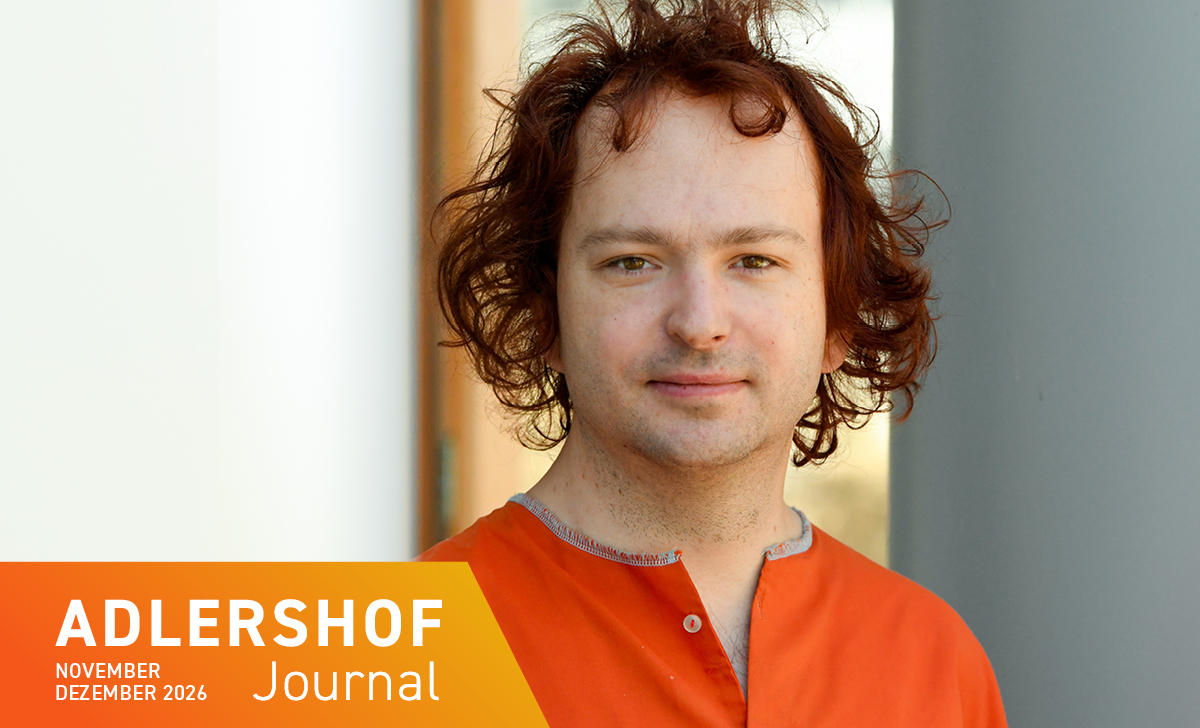
“I don’t need to know anything about filmmaking to go to the cinema,” says mathematics professor Gaëtan Borot. “In the same way, science can be part of everyone’s cultural life without people having to do science themselves.” Alongside his work at Humboldt-Universität zu Berlin, Borot wants to share his passion for mathematical subjects with an interested laymen’s audience. He is also happy to venture into unfamiliar territory himself: Together with sound artist Michael Winter, he composed a series of short musical pieces whose musical structure is based on the mathematical properties of rational numbers (examples: archive of talks/no. 259, exhibition and performance „A history of the domino problem“).
At this year’s Long Night of the Sciences, Borot joined science communicator and mathematician Demian Goos to tell stories from the world of mathematics as part of the postcard series “Gedankenidentitäten” (“Thought Identities”). The stories were also published as audio recordings. The piece below explores a concept from topology, in which a “pair of pants” is a surface with three boundary components. Such surfaces are used as basic building blocks for decomposing more complicated surfaces.
A pretzel has three handles, or “holes”. It can also be cut into four pieces that look like a Y and are probably easier to eat than the whole pretzel. Once the filling has been removed from one of these Y-shaped pieces, it looks like a pair of pants—which is why mathematicians call them just that: “pants”! The surface of a pretzel is an interesting example of a connected, closed, orientable surface. Imagine an insect crawling across your pretzel. No matter where it starts, it can move along two basic axes (or directions): left/right and forwards/backwards. By taking enough small steps, it can look at every point in the available “space”. Such a space is called a surface. It considered closed if it has no edge or boundary, and the insect cannot wander infinitely far from its starting point. A bed sheet is also a surface, but it is not closed because it has an edge over which the insect could fall. The age-old belief in a flat Earth shows that the concept of a closed surface was not fully grasped for a long time. The Euclidean plane, which we work with at school or which architects use to draw their plans, is not closed because, in theory, it extends infinitely in every direction. A surface is orientable if an insect crawling on it can never have its left and right sides reversed. The Möbius loop and the Klein bottle are examples of non-orientable surfaces. Finally, the adjective “connected” simply means that the pretzel consists of a single piece.
Closed surfaces can take different forms: the surface of the Earth has no handle, the surface of a cup has one, the surface of a pair of spectacles has two (the ones that hold the lenses in place), and the surface of a pretzel has three. But we see these shapes from the “outside”. Can insects distinguish between these different properties, too? Can it tell whether a surface has one, two, or three holes? It is a perfectly reasonable question: after all, it moves around on the surface rather than looking at it from the outside. And the answer is yes. Just as humanity was able to establish that the Earth is a sphere, a hole can also be detected from within a surface if the insect finds a closed path that cannot be reduced to the boundary of a small patch.
Following numerous contributions in the second half of the 19th century, among them the work of Riemann, Klein, Poincaré, Koebe and Dehn, it was possible to classify surfaces. The result is apparent, although proving it requires a great deal of mathematics: every connected, closed, orientable surface that does not look like the surface of an orange (g=0) or a cup (g=1) looks like an elastic pretzel with g handles. No other shapes are possible! What is more, any such surface can be decomposed into 2g-2 pairs of pants by making 3g-3 cuts. This single number, 2g-2, is known as the characteristic of the surface and uniquely determines its shape.
The characteristic is a measure of the complexity of a surface. The larger it is, the more pairs of pants we need to build up its shape. But very often, understanding what happens in each individual pair of pants is all we need in order to deduce properties of the entire surface. That is why mathematicians are so interested in making and counting pairs of pants.
Gaëtan Borot for Adlershof Journal
Curios to read more? You can find more mathematical stories here:
Gedankenidentitäten – Demian Goos – Maths, SciCom and Outreach
Prof. Dr. Gaëtan Borot — Department of Mathematics at HU Berlin