
When order gives way to chaos: the turbulent birth of magnetic nanovortices
Research team makes the effect of short electrical pulses on a skyrmion directly visible
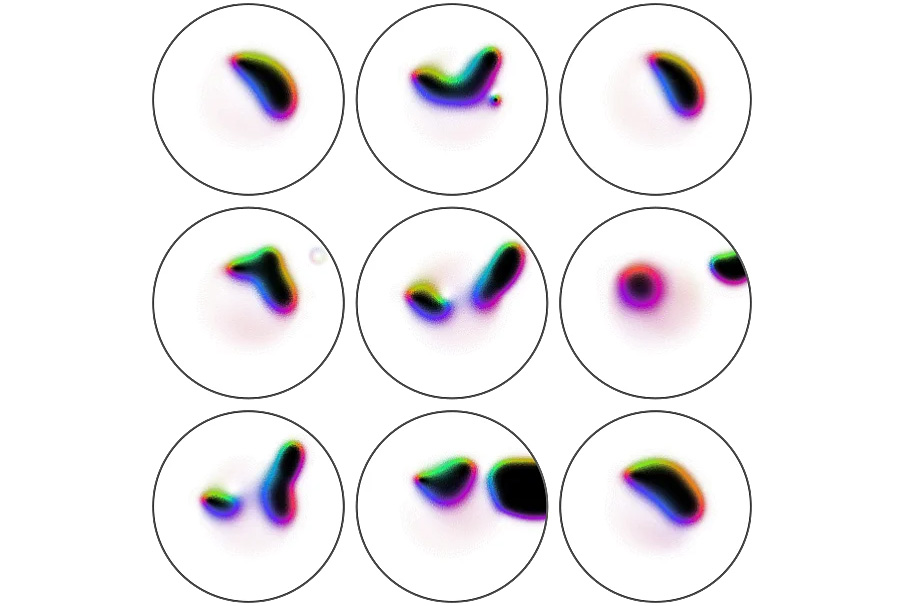
Magnetic switching processes are considered a prime example of controllable physics at the nanometer scale: in certain thin-film systems, a short electrical current pulse is sufficient to reverse the magnetization in a targeted way. The underlying effect is the so-called spin–orbit torque: the current exerts a force on the magnetic moments in the material and can thus flip them in a controlled manner. This effect is expected to enable new data storage and computing architectures in the future. Skyrmions are one particularly interesting case. These tiny magnetization vortices can be created and moved through the material using such current pulses. So far, it has been assumed that these processes take place in an orderly and predictable way – like a well-rehearsed choreography.
A team of researchers from the Max Born Institute, the Ferdinand Braun Institute, the University of Augsburg, and the Helmholtz-Zentrum Berlin has now succeeded in directly imaging the effect of short current pulses on a skyrmion. The researchers used a special form of x-ray microscopy with extremely short x-ray flashes at the synchrotron-radiation source PETRA III at DESY in Hamburg. This yielded a movie consisting of picosecond-short snapshots of the magnetization during and after a current pulse, with a spatial resolution of just a few nanometers. To capture these fleeting processes at all, the team used a focused helium-ion beam to prepare a spot of only 100 nanometers in the sample. At this spot, a skyrmion of about the same size is reliably created with every current pulse.
The surprising result: above a certain threshold for the strength of a current pulse, the skyrmion breaks up into separate parts for a few nanoseconds and evolves as a disordered pattern in turbulent motion. Accompanying computer simulations confirm this chaotic behavior and provide even more detailed insights into the fast processes occurring on the nanoscale. In this unstable regime, the researchers also observed for the first time a long-predicted effect known as “skyrmion shedding”. Magnetic vortices are repeatedly pinched off from the engineered spot and released into the surrounding material, much like vortices detaching from an obstacle in a flowing stream.
Remarkably, this brief episode of chaos does not affect the final outcome: at the end of every current pulse, a skyrmion is reliably created at the same location. However, the observed transient turbulence changes the fundamental picture that researchers have so far had of the microscopic processes during current-induced magnetic switching. At the same time, these findings open up new possibilities, such as deliberately generating magnetic structures through these very instabilities, or even harnessing the chaos itself for novel computing concepts such as “probabilistic computing”.
Publication:
Emergent Chaos-Like Dynamics of Spin–Orbit-Torque-Driven Magnetic Transitions
L.-M. Kern, K. Litzius, V. Deinhart, M. Schneider, C. Klose, K. Gerlinger, R. Battistelli, D. Metternich, D. Engel, C. M. Günther, M.-J. Huang, K. Höflich, F. Büttner, S. Eisebitt, B. Pfau
Small (2026). https://doi.org/10.1002/smll.73778
Contact:
Max Born Institute for Nonlinear Optics and Short Pulse Spectroscopy
www.mbi-berlin.de
Dr. Bastian Pfau
+49 30 6392-1321
Bastian.Pfau(at)mbi-berlin.de
Prof. Dr. Stefan Eisebitt
+49 30 6392-1300
Stefan.Eisebitt(at)mbi-berlin.de
MBI press release, 21 May 2026