
The protein maker
Bernd Haase’s company supplies molecular diagnostics with highly purified enzymes
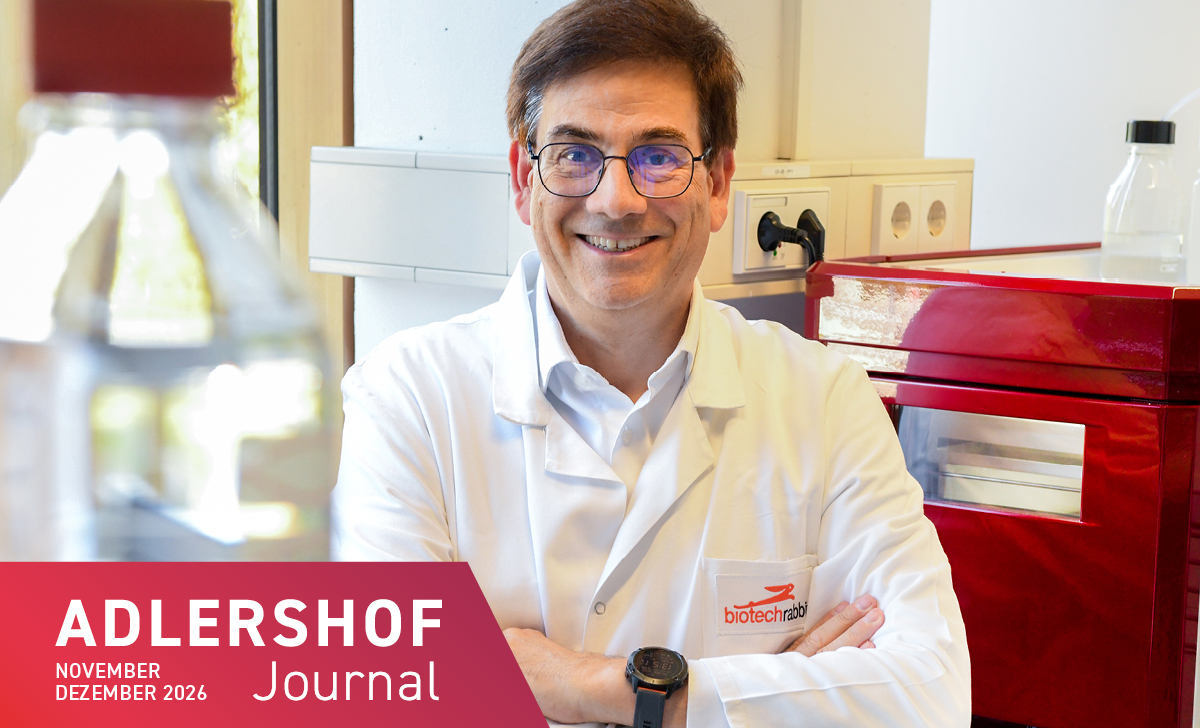
Bernd Haase sums up the concept of value creation in the simplest possible terms: “Creating something new.”
At his company on Volmerstraße in Berlin’s Adlershof district, this philosophy is put into practice every day. The process begins with a carefully formulated nutrient medium in which specially selected, nonpathogenic laboratory strains of E. coli are cultivated. Through controlled fermentation, the bacteria produce complex proteins, which are subsequently isolated and purified using sophisticated processes.
The real challenge lies in the details: Each bacterial cell contains thousands of different proteins. Extracting the desired enzyme from the cells, separating it from other cellular components, and producing it with high purity and consistent quality requires extensive biotechnological expertise. “There aren't many companies worldwide that can do this,” says Haase.
But at biotechrabbit, value creation does not stop at producing highly purified proteins. The company also uses these proteins to develop customized reagents and complete solutions for molecular diagnostics. One of its particular strengths is the freeze-drying, or lyophilization, of sensitive enzymes and complex reaction mixtures. This technology enables the production of shelf-stable products that can be used, for example, in automated diagnostic systems. The company also develops and manufactures monoclonal antibodies and customized diagnostic solutions. The company conducts research and development, manufacturing, and quality control in accordance with internationally recognized quality standards.
For the past 15 years, biotechrabbit GmbH has supplied pharmaceutical companies, diagnostic manufacturers, and scientific laboratories with specialized proteins and reagents for molecular diagnostics and genetic testing, among other applications. Today, its portfolio comprises approximately 350 products.
Fifteen years ago, molecular biology reagents accounted for just six percent of the global diagnostics market, even though molecular testing methods offered exceptionally precise and reliable results for many diagnostic applications. Haase recognized significant, largely untapped growth potential in this market. That observation became the foundation of the business idea behind biotechrabbit.
When he founded biotechrabbit in 2011, Haase, a native of Lower Saxony, Germany, was 46 years old and already had a successful international management career behind him. After earning a German Diplom degree in biochemistry and later completing his doctorate in molecular diagnostics, he transitioned from academia to industry in early 1996. Five years later, while already holding a senior management position, he completed an Executive MBA program at Purdue University in Indiana.
The program required him to travel to the United States six times over 20 months, spending two weeks on campus each visit to attend classes and take exams. Between these sessions, he had to complete extensive assignments and read up to 300 pages per week. His assessment is characteristically understated: “That requires a high degree of resilience.”
Yet despite spending many years in senior executive roles at leading international biotechnology companies, Haase wanted more: entrepreneurial independence and the chance to turn his own ideas into reality. “I wanted to start my own business, and I jumped straight into the deep end.”
The beginnings were modest: three employees, two laboratories, and a single office in Hennigsdorf, near Berlin. Four years after its founding, the company relocated to Adlershof, where, according to Haase, it found “better opportunities for growth.”
Today, biotechrabbit GmbH occupies approximately 2,000 square meters (21,500 square feet) of laboratory and office space across two floors at the biotechnology center and employs 45 people. Since 2022, the company has also maintained an office in Shanghai. Establishing a further presence in the United States is among its future expansion plans.
Southeastern Berlin has also become the center of Haase’s personal life. He lives in Köpenick and, as a water sports enthusiast, particularly appreciates the area's many lakes, rivers, and forests. He also enjoys exploring the surroundings by bicycle, passing Lake Müggelsee, the Dahme River, the ferry, and the local beaches — “a wonderful route.”
One question remains: Why biotechrabbit? What is a rabbit doing in the company's name? Well, rabbits and hares look remarkably similar, and the founder's last name, Haase, closely resembles the German word Hase, meaning “hare.” In the company logo, the long-eared mascot leaps gracefully and energetically over the lettering. Customers seem to like it: “People often come up to us at trade shows and ask about it.”
And after all, as Haase points out, “A company can be called Apple, too …”