
Research team has developed an alternative spectral imaging method
Quantum interference makes MIR spectroscopy possible using simple camera technology
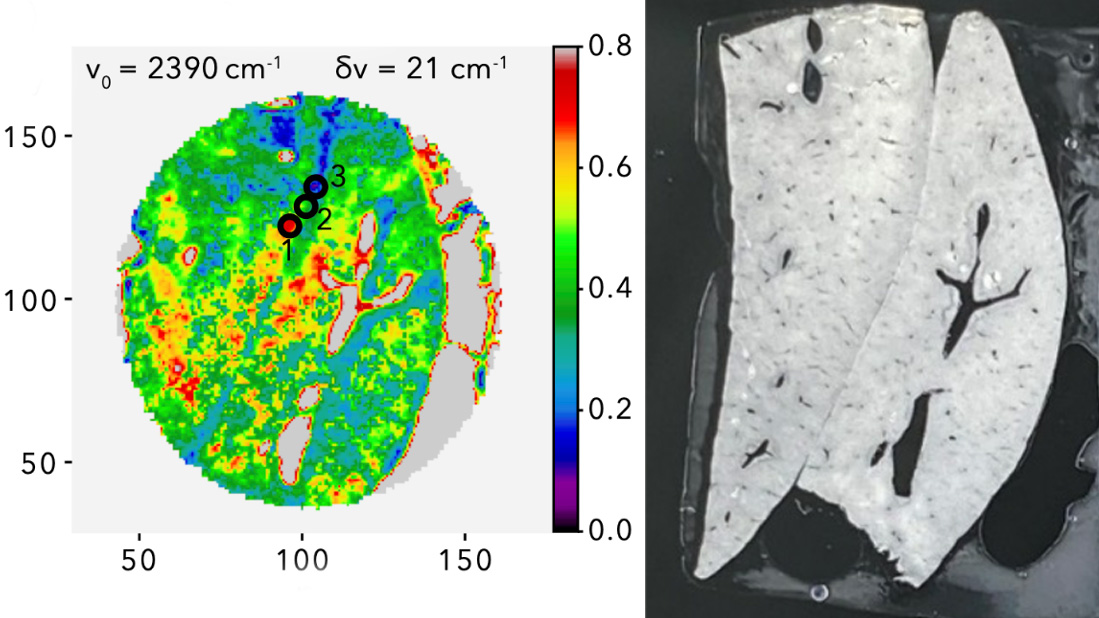
Mid-infrared (MIR) spectroscopy uses the molecular fingerprints of samples to perform biomedical or environmental analyses without chemical staining or labeling. Highly specific vibrational states of the different molecules contained therein provide characteristic signatures. Infrared spectroscopy thus allows almost any sample to be examined (bio)chemically in a non-destructive manner and without pretreatment.
In practice, however, widespread use often fails due to the complex and cost-inefficient MIR technology. Compared to established, marker-based methods, the light sources and detectors required for such spectroscopic methods are often not yet practical, for example for use in clinics.
A research team from Humboldt-Universität zu Berlin and the Ferdinand-Braun-Institut (FBH) within their Joint Lab Nonlinear Quantum Optics has now developed an alternative spectral imaging method in collaboration with Fraunhofer IPM in Freiburg. Using the quantum-optical effect of sensing with undetected photons, the researchers transfer molecular MIR information from biological and industrial samples into the detection range of silicon-based cameras. All that is needed is a cost-effective red laser pumping a special nonlinear crystal that generates entangled photon pairs, each consisting of a near-infrared and a mid-infrared photon.
Interference between two such photon-pair generation processes transfers the spectral information of the MIR photon to the near-infrared range. By combining imaging optics and Fourier-transform spectroscopy, not only two-dimensional imaging information but also spatially resolved MIR transmission spectra of the respective samples are recorded. The result is a three-dimensional data set consisting of spatial and spectral information. On this basis, the biochemical composition of tissue samples, for example, can be visualized – without markers and without direct MIR detection.
Parallel to the further development of the underlying measurement principle, the FBH is developing compact interferometer modules in its Laser Modules Lab. These modules lay the foundation for transferring the process to practical applications in the fields of medical technology and environmental analysis.
This work is funded by the German Federal Ministry of Research, Technology, and Space (13N15944, 13N16384) and was recently published in the Optica Journal by the publishing company of the same name.
Publication:
Mid-IR hyperspectral imaging with undetected photons
Marlon Placke, Chiara Lindner, Felix Mann, Inna Kviatkovsky, Helen M. Chrzanowski, Hendrik Bartolomaeus, Frank Kühnemann, Sven Ramelow
Optica 13, 328-335 (2026), https://doi.org/10.1364/OPTICA.573220
Contact:
Ferdinand-Braun-Institut gGmbH,
Leibniz-Institut für Höchstfrequenztechnik
Gustav-Kirchhoff-Str. 4, 12489 Berlin
+49 30 6392-2600
pr(at)fbh-berlin.de
www.fbh-berlin.de
FBH press release, 6 March 2026