• Skip to Page content
  • Skip to WISTA Sites
  • Skip to Main menu
WISTA
  • WISTA
  • WISTA.Plan
  • WISTA.Service
  • Adlershof
  • Charlottenburg
  • South West
  • Marzahn
  • WISTA direkt
  • Search
    • de
    • en
  • WISTA
  • WISTA Management
    • Mission / Management
      • Company Profile
      • Team
      • Boards
      • Annual Reports
      • Invitations to tender
      • Business Office Zukunftsorte
    • Sustainability / Diversity
    • Subsidiaries
    • Directions
  • News / Press
    • Overview
    • News
    • Events / Calendar
      • Diversity Conference Adlershof
    • Social Media Wall
    • Press
    • Magazine “Potenzial”
    • Adlershof Journal
    • Downloads
  • Services
    • All WISTA services
    • Business programmes
      • Adlershof Startup Lab
    • Networks / Cooperations
    • Talent promotion / Recruiting
    • Event and Visitors Service
  • Projects
    • Focus Topics
    • Team Innovation
  • Sites
    • Overview
    • Technology Park Adlershof
      • Business Directory
    • Innovation Centre CHIC Charlottenburg
    • Innovation Campus FUBIC South West
    • CleanTech Business Park Marzahn
    • House of Games Berlin
    • Zukunftsorte Berlin
  • Real Estate
    • Current Real Estate Offers
    • ST3AM Working Environments
    • Facility Management
  • Talents
    • Overview
    • WISTA as Employer
      • Jobs
    • WISTA Academy
    • Talent Promotion / Training
      • idea2action
      • workhier! Young Academics Career Programme
  • WISTA
  • WISTA.Plan
  • WISTA.Service
  • Adlershof
  • Charlottenburg
  • South West
  • Marzahn
WISTA direkt
  • Home WISTA Management
  • News / Press

News / Press

  • Overview
  • News
  • Events / Calendar
  • Social Media Wall
  • Press
  • Magazine “Potenzial”
  • Adlershof Journal
  • Downloads
  • Editorial Staff
  • Home WISTA Management
  • News / Press
04. November 2026

Only at BESSY II worldwide: IR nanoscopy at very long THz wavelengths

New experimental options at the Helmholtz-Zentrum in Adlershof
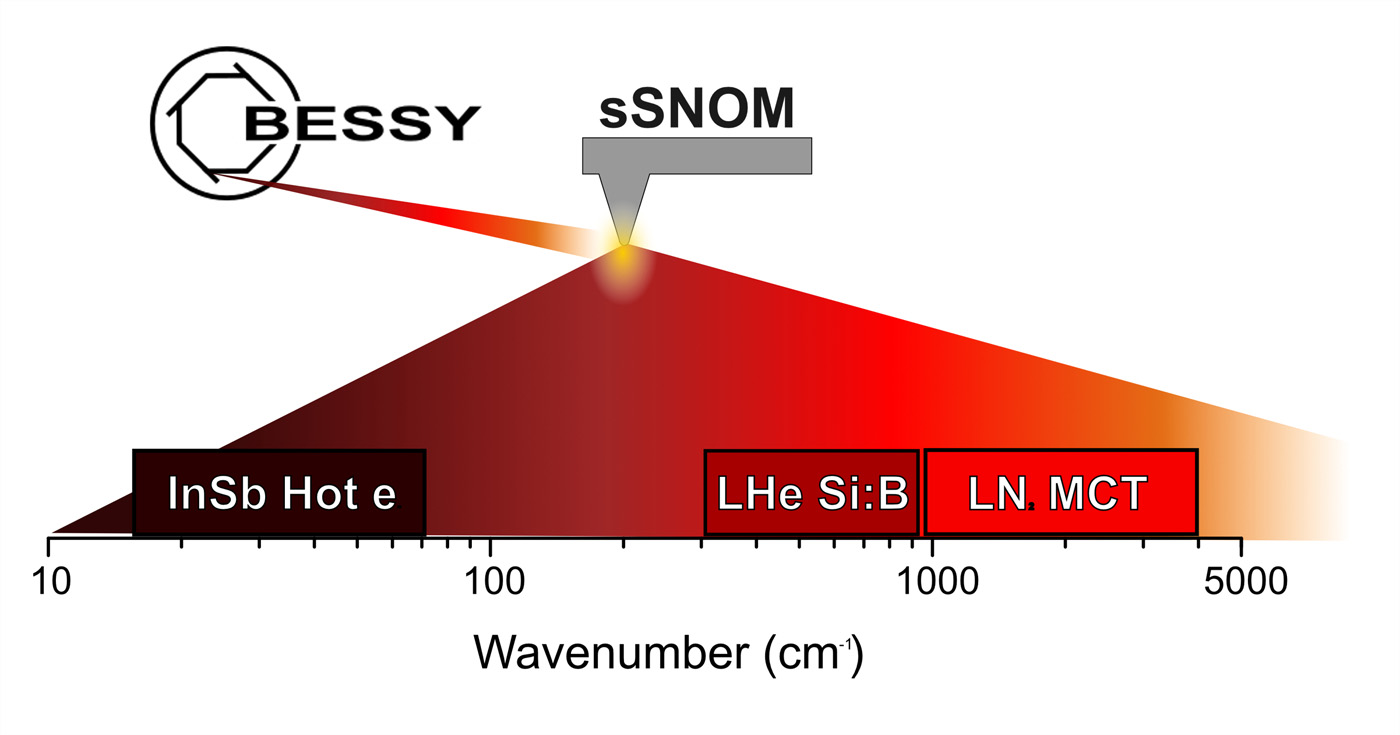
Diagram showing three marked areas for experiments (labelled: InSb Hot e, LHe Si:B, LN₂ MCT)
The schematic picture illustrates the range of wavenumbers which now is accessible with sSNOM at the IRIS-Beamline of BESSY II. © A. Veber/HZB

The team at the IRIS beamline at BESSY II has created a new experimental option: They achieved infrared nanoscopy with a spatial resolution of around 50 nm at very long THz wavelengths. This was possible thanks to a temporal pattern of light pulses known as the low-alpha operating mode at BESSY II. Worldwide, BESSY II is the only synchrotron light source at which users could perform nanoscopy in a single setup from 25 to 4000 cm-1, a unique opportunity for ultra-broadband characterisation of complex materials at the nanoscale in both the life sciences and materials sciences.

Near-field scanning microscopy (s-SNOM), based on infrared (IR) scattering, is a versatile analytical tool. The technique enables detailed chemical characterisation using IR spectroscopy far beyond the diffraction limit in the nanometre range. Modern tunable IR laser sources cover the spectral range from approximately 550 to 7000 cm⁻¹. Using synchrotron radiation sources, s-SNOM near-field spectroscopy is now possible down to 160 cm-1 or even 100 cm-1, whilst the range below < 100 cm-1 was previously not covered.

Now, a team led by Dr Alexander Veber has demonstrated at a commercially available s-SNOM system at the IRIS beamline at BESSY II experiments in the spectral range from 25 to 55 cm-1 and with a spatial resolution of 60 nm. The big advantage: The same optical configuration can now be used for nanoscopy in the range from 25 to 4000 cm-1. Conducting experiments across the THz, far-infrared and mid-infrared spectral ranges in a single setup offers a unique opportunity for ultra-broadband characterisation of complex materials at the nanoscale in both the life sciences and materials sciences.

The key condition is the so-called ‘low-alpha’ operating mode at BESSY II which offers a significant advantage in terms of flux and brilliance in the THz range. The extension of nanospectroscopy to the lower energy ranges enables the investigation of phenomena such as collective lattice vibrations, plasmonic oscillations, charge carriers and intermolecular interactions.

Note: The authors thank HZB-BESSY for the allocation of beam times at beamline IRIS. Funding by the German Federal Ministry for Education and Research (BMBF) project 05K19KH1 (SyMS) is gratefully acknowledged.

Publication:

Applied Physics Letters (2026): “THz near-field nanoscopy employing coherent synchrotron radiation”
Alexander Veber, Maria Eleonora Temperini, Ljiljana Puskar, Ulrich Schade
DOI: 10.1063/5.0348188

Contact:

Dr. Alexander Veber
Helmholtz-Zentrum Berlin für Materialien und Energie (HZB)
Institute for Electronic Structure Dynamics
+49 30 8062-13443
alexander.veber(at)helmholtz-berlin.de


HZB press release, 30.10.2026

Research Analytics Microsystems / Materials

Related News

Schematic illustration of two molecular samples of different sizes, connected by an arrow

High-resolution insights into individual biomolecules and catalysts

Nanoscale infrared spectroscopy improves the ability to study biological and chemical processes at BESSY II
Depiction of a cell being examined with a microscope beam

What vibrating molecules might reveal about cell biology

At BESSY II, molecular vibrations in tiny biological samples can now be detected and analysed

IRIS beamline at BESSY II extended with nanomicroscopy

The new nanoscope enables nanospectroscopy and nanoimaging of structures smaller than a thousandth of the diameter of a human hair

Related Institutions

  • Helmholtz-Zentrum Berlin für Materialien und Energie GmbH, Elektronenspeicherring BESSY II

Share this page

  • © WISTA Management GmbH
  • Legal Notice
  • Privacy Policy
  • Digital Accessibility
  • Contact
  • Career
  • Press
  • Social Media Guide
Member of:
Zukunftsorte Berlin Logo