
Materials chemistry shapes the future of catalysis
Emerging developments in operando analytics, data-driven discovery and autonomous robotics are transforming synthesis into the central tool for the targeted development of smart and adaptive electrocatalysts
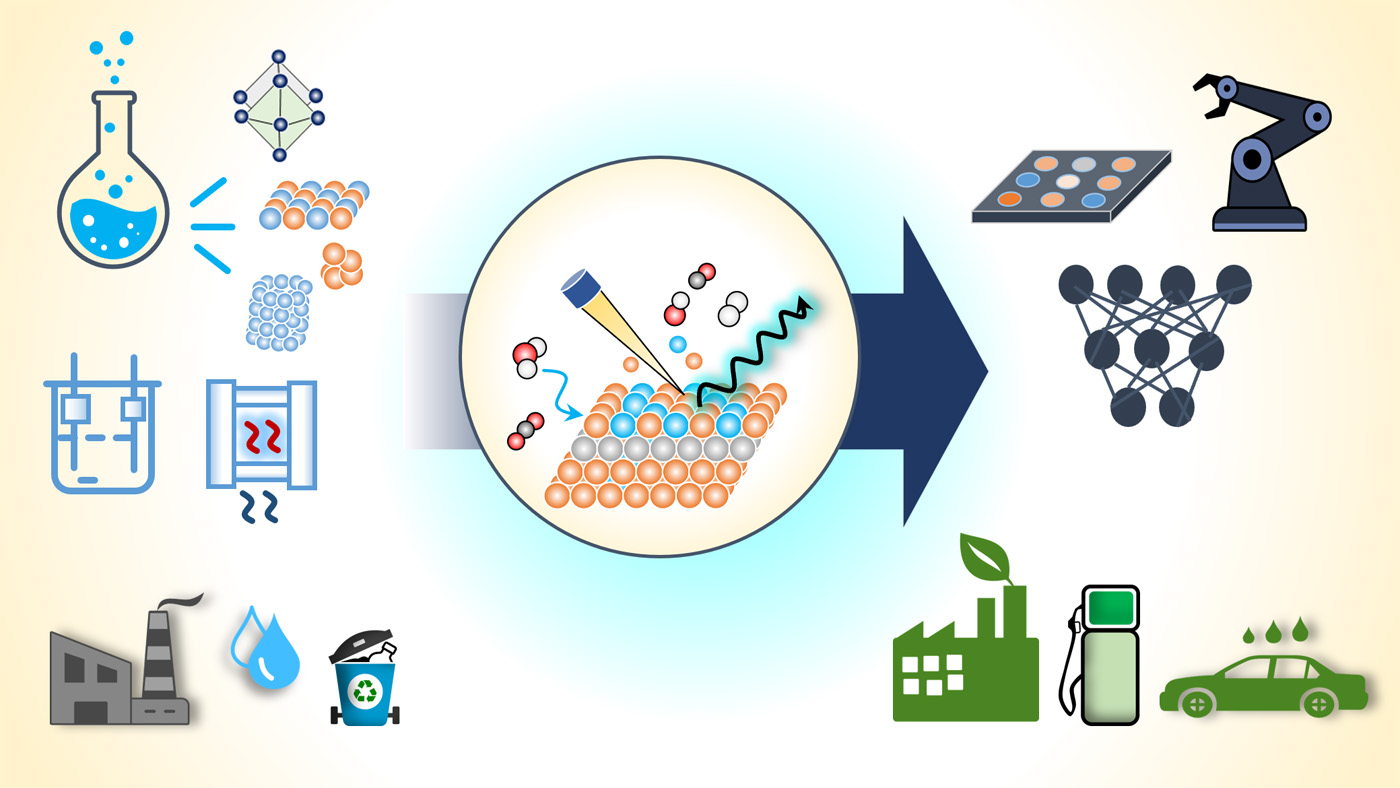
The synthesis of materials can serve as a tool for developing smart, adaptive electrocatalysts. This rapidly evolving field of research involves in-situ analytics, data-driven discoveries and autonomous robotics. These new approaches could accelerate the discovery of long-lasting and efficient catalysts for future energy conversion and the decarbonisation of the chemical industry. A recent article by Dr Prashanth Menezes and his team in the renowned journal Angewandte Chemie provides an overview of this research.
The global transition to sustainable energy technologies is accelerating. In the future, the chemical industry will replace fossil fuels with green hydrogen or hydrocarbons produced via electrocatalysis to manufacture products on a large scale. However, the electrocatalysts required for this remain a bottleneck. These catalysts must be made from widely available, inexpensive materials that perform their catalytic function selectively, efficiently, and stably.
Synthesis as a tool
‘What if the biggest breakthroughs in electrocatalysis may not come from chasing better performance metrics, but from how we design and synthesize the materials themselves?’ asks Dr Prashanth Menezes. The researcher, who heads the Department of Materials Chemistry for Catalysis at HZB, has published a review article with his team in the renowned journal Angewandte Chemie. The article covers the full range of synthetic methods, from solid-state synthesis and wet-chemical strategies to electrodeposition and interfacial growth methods.
Properties and transformations
‘In electrocatalysis, we often focus on activity, selectivity and durability, but these properties do not emerge by chance. They are already born during synthesis,’ says Menezes. A material’s phase, crystallinity, defect density, oxidation state, morphology, conductivity and local coordination environment are all determined by the synthesis chemistry. These features then dictate how active sites form, how charges and ions move, and even how the catalyst transforms under reaction conditions.
The review article highlights common synthesis strategies and demonstrates how these affect the catalyst’s properties and performance. ‘In many cases, the catalyst that we synthesise does not perform the reaction itself. The true active material develops in situ during operation,' explains Dr Debabrata Bagchi. Understanding and controlling this transformation is one of the key challenges of modern catalysis research.
Robotics and AI
‘We also highlight new developments in in situ analytics, data-driven research and autonomous robotics, and discuss how these can improve our understanding of, and ability to predict and reproduce, material synthesis processes, as well as increasing their throughput,’ says Dr Niklas Hausmann. One section addresses the industrial relevance of electrocatalysis, explaining how advances in synthetic chemistry influence the use of catalysts in electrolysers, CO₂ reduction reactors, and other electrochemical technologies under realistic conditions.
The future of catalysis
These new approaches can accelerate the discovery of long-lasting and efficient catalysts for future energy conversion and the decarbonisation of the chemical industry. ‘Synthesis is no longer just a preparatory step. It is becoming the central tool for the targeted development of smart and adaptive electrocatalysts,’ says Menezes. ‘We are entering a fascinating era in which chemistry, advanced characterisation, automation and AI are converging. The future of catalysis may not depend on discovering a single miracle material, but rather on learning how to systematically control matter and its evolution under working conditions, where materials chemistry will determine the future of catalysis.’
Publication:
Angewandte Chemie (2026). Linking Synthetic Materials Chemistry to Electrocatalytic Performance
Debabrata Bagchi, J. Niklas Hausmann, Tobias Sontheimer, Prashanth W. Menezes
DOI: 10.1002/anie.4318027
Angewandte Chemie (2026): Verknüpfung der synthetischen Materialchemie mit elektrokatalytischer Leistungsfähigkeit
Debabrata Bagchi, J. Niklas Hausmann, Tobias Sontheimer, Prashanth W. Menezes
DOI: 10.1002/ange.4318027
Contact:
Helmholtz-Zentrum Berlin für Materialien und Energie
Department Materials Chemistry for Catalysis
Jan Niklas Hausmann
(030) 8062-15175
niklas.hausmann(at)helmholtz-berlin.de
Debabrata Bagchi
(030) 8062-15177
debabrata.bagchi(at)helmholtz-berlin.de
Dr. Prashanth Menezes
(030) 8062-15174
prashanth.menezes(at)helmholtz-berlin.de
Press Officer
Dr. Antonia Rötger
(030) 8062-43733
antonia.roetger(at)helmholtz-berlin.de
HZB press release, 29 May 2026