
In the flow with Lego
Whether plastic bricks, photovoltaics, or fungi, creativity in Adlershof flourishes where people from different backgrounds, disciplines and perspectives come together
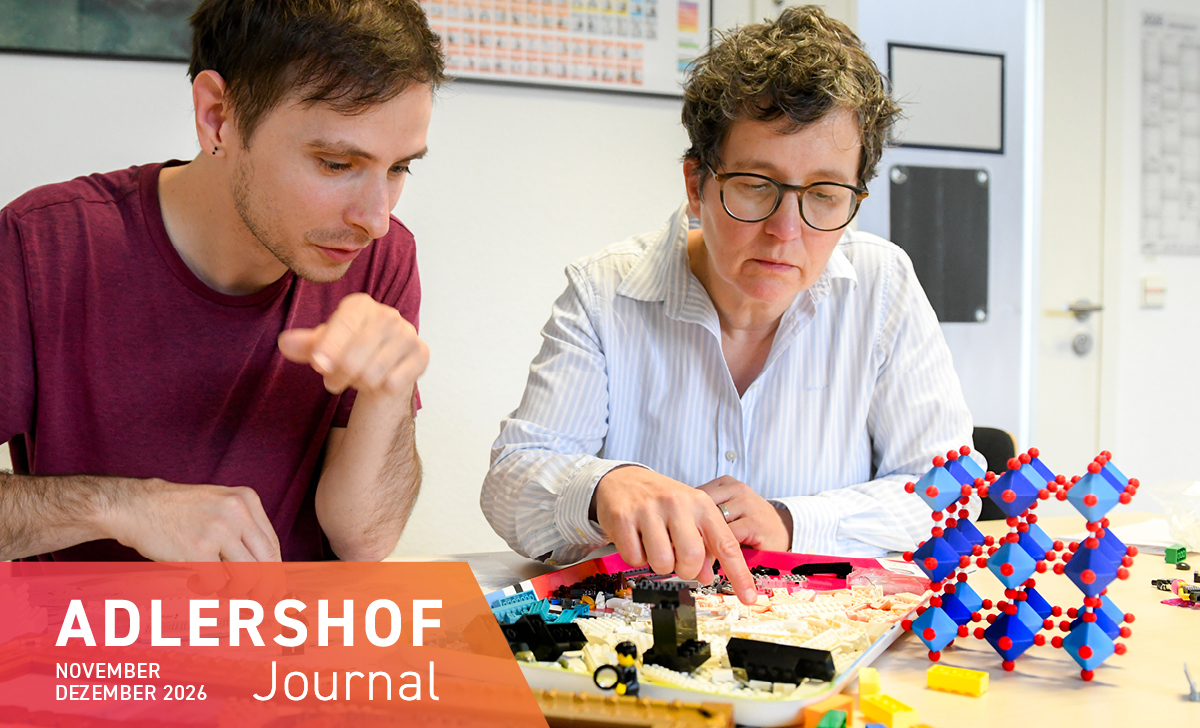
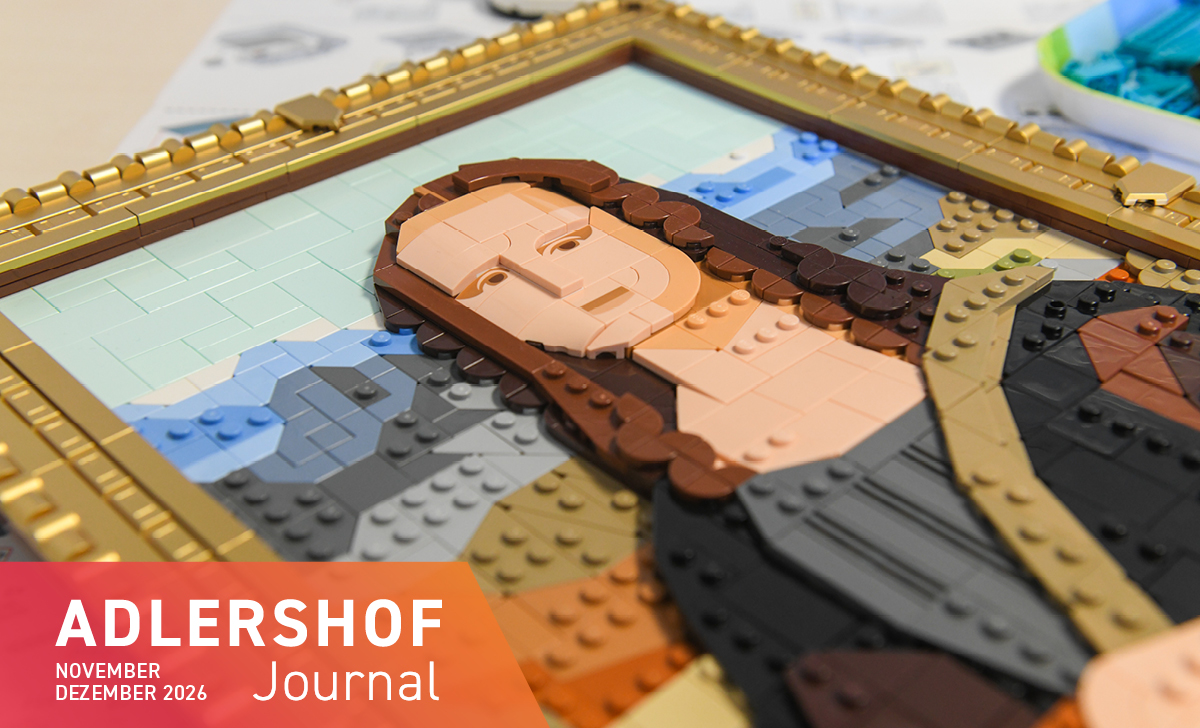
A quick glance at some Lego bricks is enough to make Franziska Emmerling’s fingers itch. Children’s toys? Some might say so. But toys that spark creativity and make abstract concepts tangible. “I’m fascinated by how simple building blocks can be used to represent complex three-dimensional relationships,” says Emmerling, who is head of the Materials Chemistry division at the Federal Institute for Materials Research and Testing (BAM). In so-called metal-organic frameworks (MOFs), for example, Lego can be used to demonstrate how metal nodes and organic linkers come together to form these porous networks. Her work as a professor and what might seem like a mere pastime combine to form the very essence of what drives her: “Developing good questions, gaining a better understanding of complex materials and creating an environment in which people can conduct research independently, critically and creatively.”
Emmerling combines her passion for Lego with issues of science communication and collaboration. “Luckily for me, Lego has positive associations for many people,” she says. “It sparks curiosity, brings back memories, awakens the urge to play and makes people willing to give things a try.” This lowers the threshold for them to engage with complex scientific questions, too. “A model on the table is more likely to invite people to take a closer look, ask questions and explore ideas together than just an abstract diagram,” Emmerling explains.
This is but one thing that can help get ideas flowing. When a research problem reaches a dead end, Emmerling initially steps back and reframes the original question: Which assumption have I been taking for granted? What information is missing? Could a result that does not fit the existing picture actually point to something new? New approaches often emerge through conversation. “It needs two to think,” Emmerling knows. In other words, exchanging ideas with her team and colleagues from other disciplines makes it possible to look at data and relationships in a new way. Plus: “I do a lot of doodling—not for its own sake, but because drawing helps me make conceptual structures visible and discover new connections.” This is another trick she has to get her creativity unstuck.
Working in a team with a diversity of experience is also important to her: Different academic backgrounds, career stages, international experience and perspectives help us question established habits and avoid taking things for granted,” she says. But she is keen to emphasise: “Diversity alone is not enough. What matters is a working culture in which people feel able to contribute their ideas, doubts, and even unconventional suggestions. That is often where the most interesting scientific approaches emerge.”
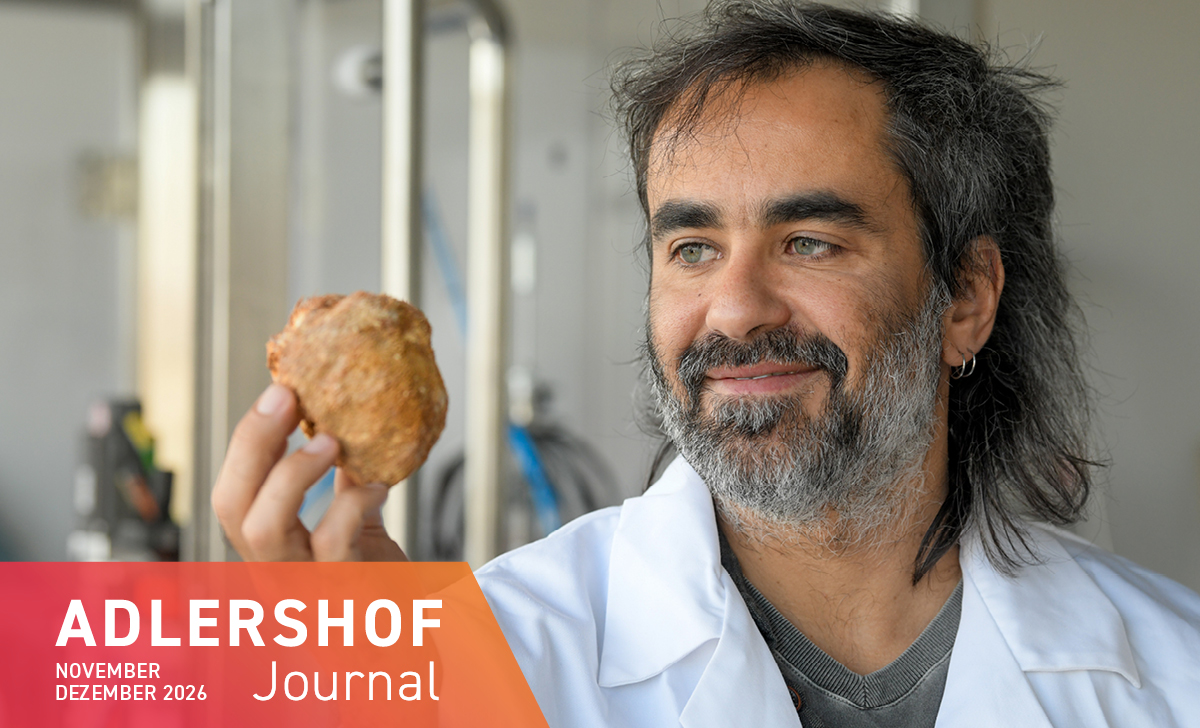
For Bruno Leal, too, creativity does not begin with a single flash of inspiration. A native of Brazil, he is CEO and founder of Cogu GmbH, an Adlershof-based company that produces organic functional liquid extracts from mushrooms and plants. While most suppliers focus on extracts containing individual substances, Cogu develops blends designed to support specific bodily functions, such as digestion, relaxation and immune defence. “We believe it is easier for people to understand what something does than an isolated ingredient,” Leal explains. The products are developed, manufactured and bottled at the Centre for Photovoltaics and Renewable Energies, where the company is headquartered.
Leal came to Cogu via a somewhat roundabout route, having spent many years working in the financial sector. “I had no idea what I wanted to do next. But I knew very clearly that it would no longer be in finance,” he recalls. It wasn’t a creative flash that led to the founding of his company: “The business emerged more from a gradual accumulation of observations and frustrations than from a single, decisive lightbulb moment.”
That gradual process still shapes the way his team works today. “At Cogu, some things emerge through experimentation and chance, while others come about through targeted testing and the exchange of different perspectives.” Leal has not lost the analytical eye he developed in finance: “Having different experiences means I can look at problems from different angles.”
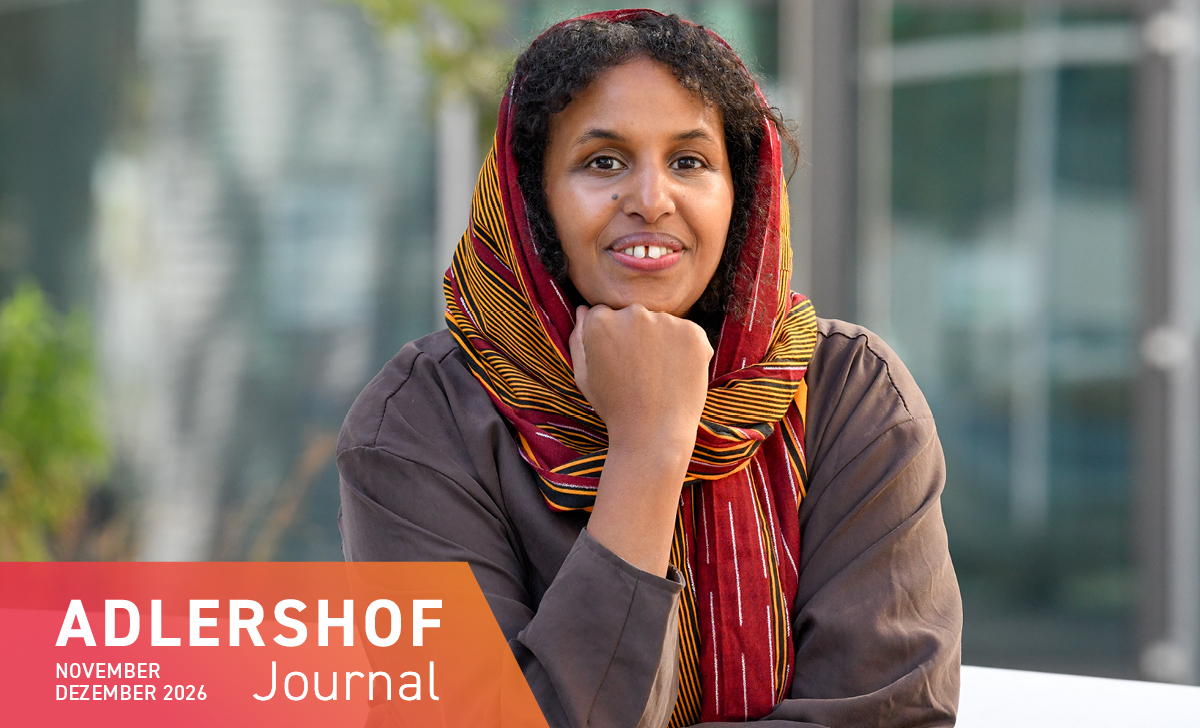
For Samira Aden, creativity begins with asking the right questions. The architect and design researcher works at the Competence Centre Photovoltaics Berlin (PVcomB) at Helmholtz-Zentrum Berlin (HZB), at the intersection of architecture, art, and new technologies. This is an environment that is inherently conducive to creative thinking: “In architecture, we often have a clearly defined framework: a location, a brief, a budget and specific requirements,” she explains. “In research, things are much more open. We work with materials and technologies whose potential is not yet fully understood.” And that is what makes it exciting: “We are not simply designing a solution; first, we have to work out which questions should be asked in the first place.”
Aden thinks in terms of space, materiality, perception and use. Photovoltaics, for example, fascinates her not simply as a technology for generating energy. “A technical component suddenly becomes an architectural material.” It is all about the interplay between energy, light, surfaces, construction and space. “I see creativity in this context as a kind of catalyst: between disciplines, between different forms of knowledge, and between what is possible today and what we have yet to imagine,” Aden says with emphasis.
This is particularly evident in building-integrated photovoltaics. For Aden, the most exciting solutions emerge when we stop thinking of photovoltaics as an “additional technical layer”. Energy can become part of the architectural identity of a building, a city and a society. Achieving this requires architects to work together with materials scientists, physicists, engineers, artists, politicians and users. Such interdisciplinarity lays the foundations for innovation. But: “An interdisciplinary team alone does not make collaboration interdisciplinary. What is needed is a shared culture of listening, translating and challenging one another.”
This approach was also reflected in Aden’s work as curator of the Pan-African Biennale in Nairobi. She does not see Africa as a “case study” but as a source of knowledge and ideas for the future. Looking at existing resources and knowledge accumulated over generations can lead to new research questions. “Many innovations do not arise from having resources in abundance but from the ability to establish new relationships between the resources we already have,” Aden says.
What, then, do people need to be creative? Creativity requires time, trust and the freedom not to have to be right straight away,” Aden believes. It also requires a willingness to embrace “productive irritation”. In other words: “Not simply continuing with things because they work, but deliberately asking whether we are still defining the problem correctly.”
Chris Löwer for Adlershof Journal
Materials Chemistry at the Federal Institute for Materials Research and Testing (BAM)
cogu. functional mushrooms & botanicals
Business card Samira Jama Aden at Helmholtz-Zentrum Berlin (HZB)