
Electrocatalysts: New model for charge separation at the solid-liquid interface
New model describes the processes at the interface for the first time, thereby enabling targeted strategies for material design
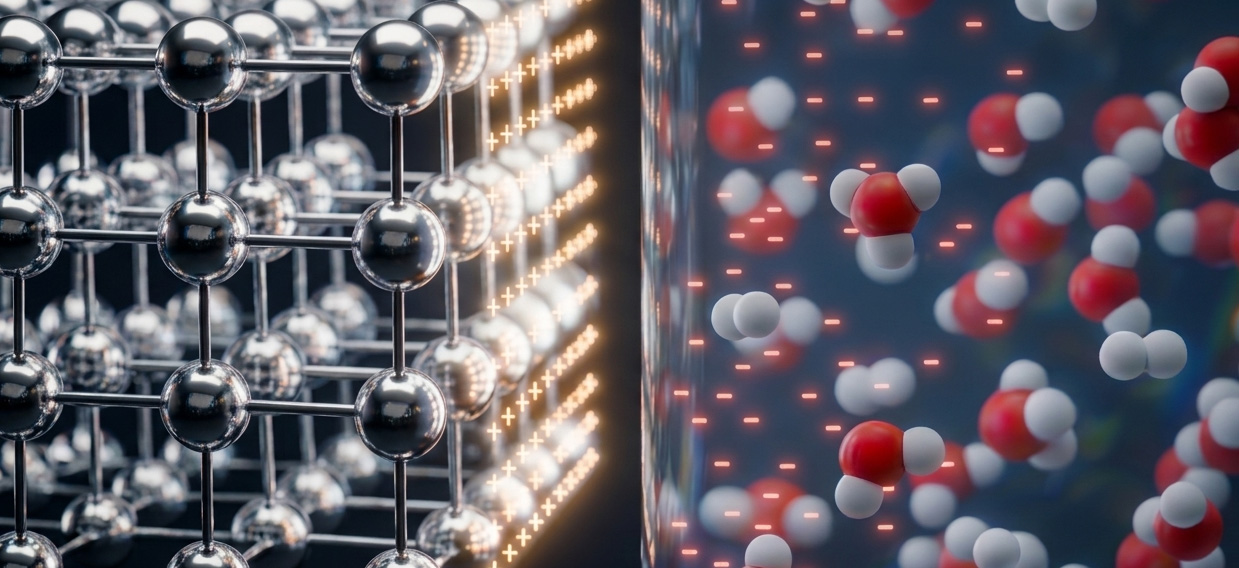
Hydrogen is at the heart of the transition to carbon neutrality, as both an energy carrier and a reagent for green chemistry. However, large-scale production of hydrogen via electrolysis, as well as the production of many other chemical products, requires significantly cheaper and more efficient catalysts. A precise understanding of the electrochemical processes that take place at the interface between the solid catalyst and the liquid medium is highly useful for developing better electrocatalysts. In the journal Nature Communications, an European team has now presented a powerful model that determines charge separation at the interface, the formation of the electric double layer and local electric potential variations, and the resulting influence on the catalytic activity.
Electrocatalysis is a technology with enormous potential: with suitable electrocatalysts and green power, hydrogen can be produced nearly without climate impact, or – another important example – CO2 can be converted into hydrocarbons. Unfortunately, conventional catalysts consist of rare precious metals such as platinum or iridium. Cost-effective catalysts have only been developed for certain sub-reactions so far, such as those made from transition metal hydroxides. However, research has shown that coating metallic surfaces with nickel hydroxide nanoclusters can also increase the catalytic activity.
Until now, however, it was unclear why this works. ‘Although changes in the structure of the electrolyte near the interface have been evidenced, there was no clear understanding of what occurs at the boundary between a solid electrode and a liquid electrolyte, where these reactions take place. This interface is inherently complex, as it involves both the physics of the solid material and the chemistry of the liquid,’ says Arsène Chemin from the Institut Lumière Matière and the Université Claude Bernard Lyon 1.
Chemin and his colleague, David Amans, developed in collaboration with Tristan Petit and Louis Godeffroy, Helmholtz-Zentrum Berlin, a solid-state physics-based model for describing the metal/semiconductor/electrolyte interface during electrocatalysis. By considering the Fermi level with the chemical potential in a unified picture, the model bridges solid-state physics and chemistry, and provides a direct link to electrocatalytic formalisms such as Butler–Volmer kinetics.
‘Specifically, we account for the interfacial potential barriers and electric fields induced by charge transfer. In doing so, we uncover the origin of charge separation at the interface and demonstrate how an electric double layer forms, which influences the local electric potential,’ says Petit. ‘In fact, the local electric potential appears to be the limiting factor for catalytic activity for most of the metal electrodes!’, adds Chemin. The model also provides insights into how the electrocatalytic activity of thin-film catalysts can be enhanced by mitigating this potential; for instance, by depositing a thin semiconductor layer (1 to 10 nm) onto a metal electrode. It provides theoretical criteria for designing effective electrodes and guiding the development of new materials.
The model provides a more detailed insight into electrochemical behaviors at solid-liquid interfaces. This could facilitate the development of more efficient materials for applications such as electrocatalysis, batteries, and energy conversion technologies, by enabling the implementation of targeted strategies.
Publication:
Nature Communications (2026): The role of the Helmholtz potential on electrocatalytic activity
Arsène Chemin, Louis Godeffroy, David Amans & Tristan Petit
DOI: 10.1038/s41467-026-70980-5
Contact:
Dr. Arsène Chemin
Université Claude Bernard Lyon 1
Institut Lumière Matière
arsene.chemin(at)univ-lyon1.fr
www.arsenechemin.com
Dr. Tristan Petit
Helmholtz-Zentrum Berlin für Materialien und Energie (HZB)
Young Investigator Group Nanoscale Solid-Liquid Interfaces
(030) 8062-17153
tristan.petit(at)helmholtz-berlin.de
Dr. Antonia Rötger
Helmholtz-Zentrum Berlin für Materialien und Energie (HZB)
Press Officer
(030) 8062-43733
antonia.roetger(at)helmholtz-berlin.de
HZB press release, 16 April 2026