• Skip to Page content
  • Skip to WISTA Sites
  • Skip to Main menu
WISTA
  • WISTA
  • WISTA.Plan
  • WISTA.Service
  • Adlershof
  • Charlottenburg
  • South West
  • Marzahn
  • WISTA direkt
  • Search
    • de
    • en
  • WISTA
  • WISTA Management
    • Mission / Management
      • Company Profile
      • Team
      • Boards
      • Annual Reports
      • Invitations to tender
      • Business Office Zukunftsorte
    • Sustainability / Diversity
    • Subsidiaries
    • Directions
  • News / Press
    • Overview
    • News
    • Events / Calendar
      • Diversity Conference Adlershof
    • Social Media Wall
    • Press
    • Magazine "Potenzial"
    • Adlershof Journal
    • Downloads
  • Services
    • All WISTA services
    • Business programmes
      • Adlershof Startup Lab
    • Networks / Cooperations
    • Talent promotion / Recruiting
    • Event and Visitors Service
  • Projects
    • Focus Topics
    • Team Innovation
  • Sites
    • Overview
    • Technology Park Adlershof
      • Business Directory
    • Innovation Centre CHIC Charlottenburg
    • Innovation Campus FUBIC South West
    • CleanTech Business Park Marzahn
    • House of Games
    • Zukunftsorte Berlin
  • Real Estate
    • Current Real Estate Offers
    • ST3AM Working Environments
    • Facility Management
  • Talents
    • Overview
    • WISTA as Employer
      • Jobs
    • WISTA Academy
    • Talent Promotion / Training
      • workhier! Young Academics Career Program
      • STEM project SLE
  • WISTA
  • WISTA.Plan
  • WISTA.Service
  • Adlershof
  • Charlottenburg
  • South West
  • Marzahn
WISTA direkt
  • Home WISTA Management
  • News / Press

News / Press

  • Overview
  • News
  • Events / Calendar
  • Social Media Wall
  • Press
  • Magazine "Potenzial"
  • Adlershof Journal
  • Downloads
  • Editorial Staff
  • Home WISTA Management
  • News / Press
27. June 2025

Diffusion of hydrogen in MXene investigated at HZB

Modelling offers a solid foundation for further research with MXene as hydrogen storage systems
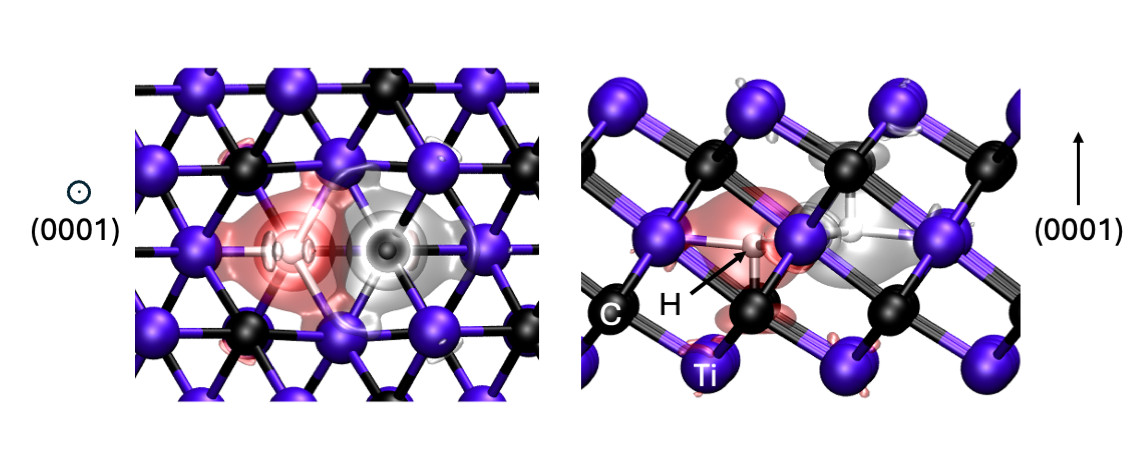
Schematic representation of the Ti3C2 crystal lattice with hydrogen and the associated bonding orbitals. Left: normal to the c-axis; right: perpendicular to the c-axis. © N. Nickel / HZB

Two-dimensional (2D) materials such as MXene are of great interest for hydrogen storage. An expert from HZB has investigated the diffusion of hydrogen in MXene using density functional theory. This modelling provides valuable insights into the key diffusion mechanisms and hydrogen's interaction with Ti₃C₂ MXene, offering a solid foundation for further experimental research.

Hydrogen is an energy carrier that can be produced in a climate-friendly way by electrolysis of water using ‘green’ electricity. However, storing hydrogen is not that easy. MXene could be a promising solution. MXene are compounds of metal and nitrogen or carbon that form a two-dimensional hexagonal structure, giving them special physical and chemical properties. Atoms and molecules, such as hydrogen, can be stored both in and between the 2D layers. ‘However, we know that hydrogen atoms and even molecules form complex bonds in MXene and on its surfaces,’ says Prof. Dr. Norbert Nickel, a physicist at HZB. When storing hydrogen, it is also important that the hydrogen bound in the material can be released when needed.

Previous neutron scattering experiments have shown that hydrogen can be stored in the MXene material Ti3C2. However, in 2024, Nickel calculated exactly how the hydrogen orbitals interact with the titanium and carbon orbitals using density functional theory. These results shed light on the nature of hydrogen's chemical bonding and how temperature affects the diffusion process (see Annalen der Physik, 536, 2400011 (2024)). Nevertheless, quantum mechanical calculations of the interactions between hydrogen atoms and molecules with Ti₃C₂ show that the simple model of chemical bonding is insufficient to describe hydrogen's bonding properties.

Recently Nickel analysed the chemical orbitals in more detail: the calculations showed that interstitial hydrogen atoms and molecules form s-like bonds with neighbouring titanium atoms and s-p hybrid orbitals with neighbouring carbon atoms.

For the diffusion process, it is important that these bonds can be broken. In solids, foreign atoms, such as hydrogen, can diffuse either via vacancies or via interstitial sites. Diffusion therefore depends on the concentration of vacancies and interstitial sites. ‘Modelling shows that hydrogen transport in Ti3C2 occurs via interstitial sites and that diffusion via vacancies plays no role,’ Nickel summarises the results. This allows hydrogen atoms and molecules in Ti3C2 MXene to achieve high mobility with diffusion coefficients of 2.4 × 10−5 cm−2/s at a moderate temperature of 500 K.

Calculations of the orbital interactions between hydrogen and Ti₃C₂ also enable the parameter ranges in which particularly interesting experimental observations can be expected to be estimated in advance for the first time, for example with spectroscopic measurements at BESSY II.

Publication:

Nano Letters (2025): Hydrogen Diffusion in Ti3C2 MXenes
Norbert H. Nickel
DOI: 10.1021/acs.nanolett.4c05749

Contact:

Prof. Dr. Norbert Nickel
Helmholtz-Zentrum Berlin für Materialien und Energie
Young Investigator Group Nanoscale Solid-Liquid Interfaces
+49 30 8062-17159
nickel(at)helmholtz-berlin.de


Press release HZB, 23 June 2025

Research Renewable Energies Grand Challenges Microsystems / Materials

Related News

Illustration of spectroscopic microellipsometry

Novel technique shines light on next-gen nanomaterials

Team from HZB and Hebrew University uses spectroscopic microellipsometry to investigate how MXenes truly work
Image from scanning electron microscope

MXenes boost the effectiveness of catalysts for the production of green hydrogen

HZB team shows a new way to highly efficient and inexpensive catalysts
Surface of a Vanadium carbide MXene © B. Schmiedecke/HZB

MXenes show talent as catalyst for the production of green hydrogen

This class of materials is more stable and efficient than the best metal oxide catalysts currently available
Scanning X-ray images of a dismounted Li-ion battery with cycled MXene electrode © HZB

MXenes for energy storage: Chemical imaging more than just surface deep

Scanning X-ray microscopy (SXM) at MAXYMUS beamline of BESSY II enables the characterization of layered materials in complex systems
The experiment at BessyII © M. Künsting /HZB

HZB team investigates charge transport in MXenes

Superstore MXene are considered an exciting new class of materials for energy storage

Share this page

  • © WISTA Management GmbH
  • Legal Notice
  • Privacy Policy
  • Contact
  • Career
  • Press
  • Social Media Guide
Member of:
Zukunftsorte Berlin Logo