
Choreography in bronze
Traditional craftsmanship creates contemporary one-of-a-kind works at Kunstgießerei Altglienicke
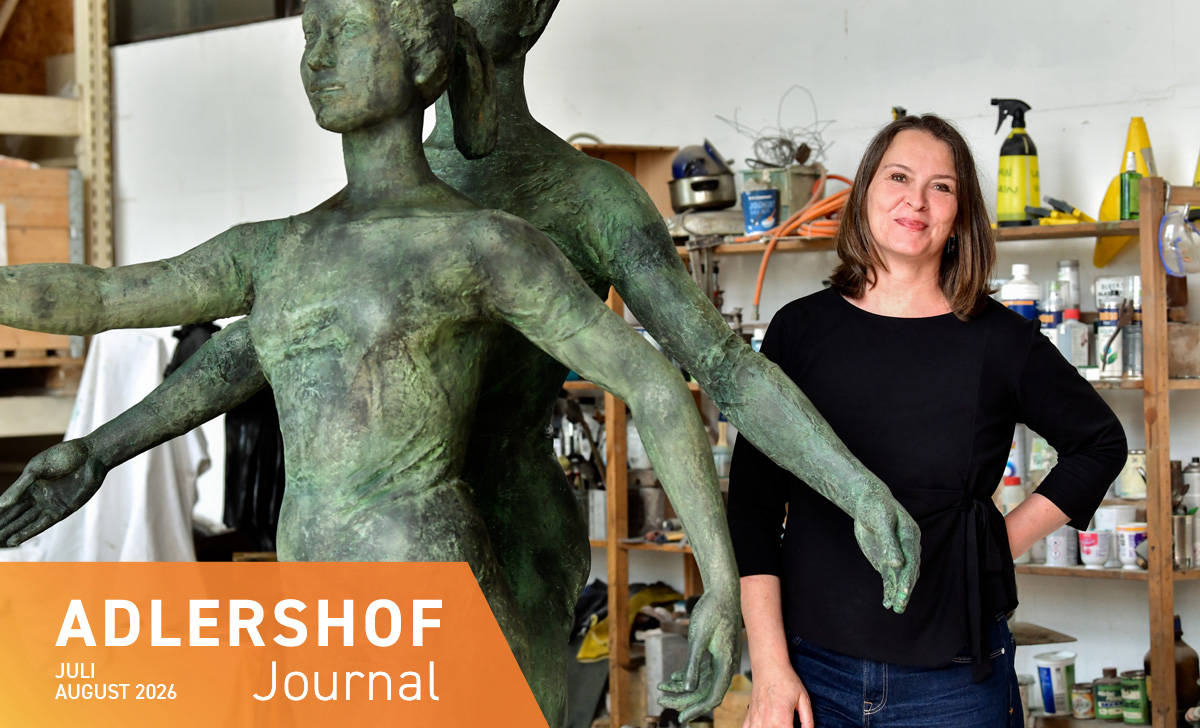
Bronze casting is one of the oldest techniques used in the history of art. At Kunstgießerei Altglienicke, Anke Schirlitz is carrying on this tradition and love for art.
An art historian and cultural manager by trade, she came to the foundry by chance. “In 2012, the then owner, Marco Flierl, was looking for an executive assistant. At first, I was intrigued by the combination of art, craftsmanship and organisation. But the deeper I immersed myself in the work, the more fascinated I became by the unique connection between artistic vision and precision.”
Schirlitz took over the foundry in 2015 and moved into a newly built 600-square-metre workshop on Wegedornstraße in 2020. “We're very happy with our location. With its large windows, the workshop has the feel of an artist's studio. Everything is close together, which is important because the team needs to coordinate closely throughout the production process.” Eight sculptors, mould makers and chasers work hand in hand. Many individual steps are required before a work of art in bronze or aluminium is created using the lost-wax casting process.
Everything begins with an original model, often made of plaster, clay, wood or even modelling clay. “We've made moulds of leather shoes for the painter Ruprecht von Kaufmann and cast them in bronze, produced plaster-reinforced dresses for the Japanese artist Chiharu Shiota, and even a leather jacket for the object artist Alexandra Bircken,” she says. When it comes to the original material, there are almost no limits. In the mould-making workshop, the models are cast using silicone. “First we create a negative mould. The size of the furnace determines the maximum dimensions. We can cast pieces up to 1.2 metres in one piece.” Larger bronze sculptures require several moulds. “A clay parting line is first applied to the original model before silicone is sprayed on. Plaster is then added to stabilise the highly flexible silicone.” To produce the wax model, the silicone mould is coated with wax and rotated until a wax layer three to four millimetres thick has formed.
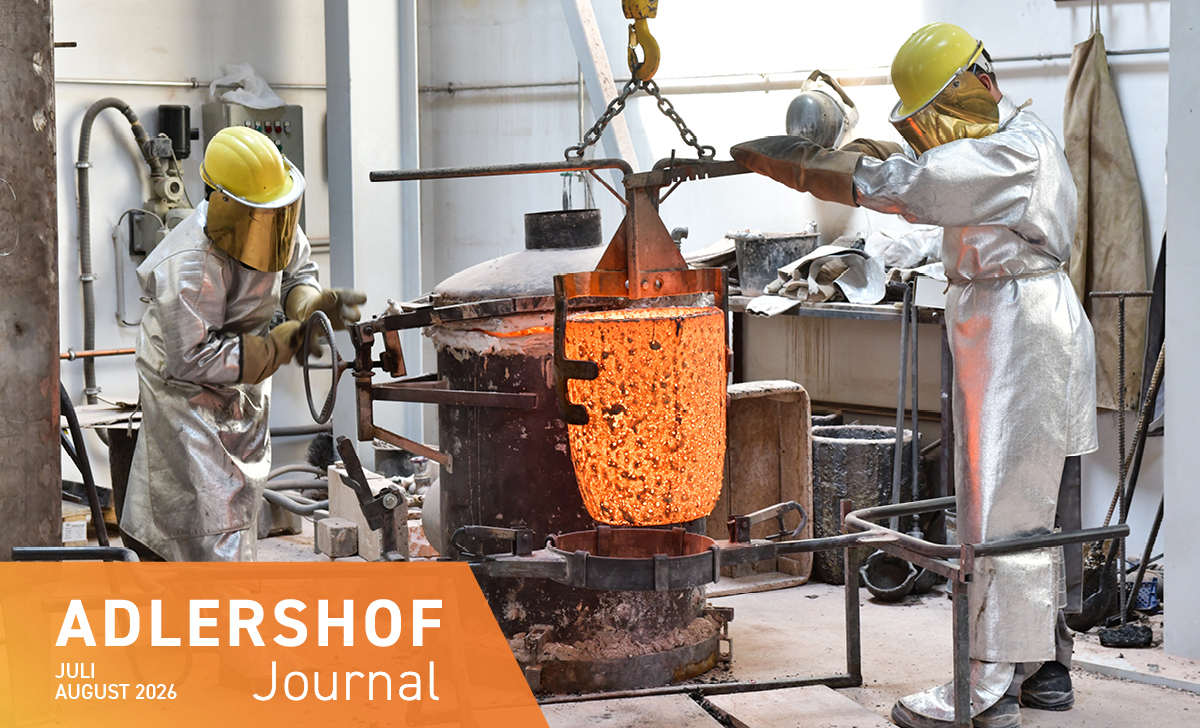
The wax models are then fitted with casting channels so that the bronze can flow through the mould during casting. They are subsequently encased in a liquid mixture of brick dust and plaster. In the drying kiln, this ceramic mould hardens while the wax melts away, leaving the cavity into which the molten bronze is poured. This firing process takes up to six days. The casting itself happens quickly so that the bronze, heated to 1,130 degrees Celsius, does not cool prematurely.
The following day, the casting can be uncovered. “The ceramic mould is chipped away and the inner core is removed with a pressure washer. Once the casting has been cleaned, the casting channels are cut off and the surface is refined. This process, known as chasing, is carried out using small chisel-like tools and fine hammers.” The final stage is patination, when the surface is coloured according to the artist's wishes. Copper nitrate produces green tones, iron nitrate red, while liver of sulphur creates brown hues by reacting chemically with the bronze. “Creating the right patina requires a real feel for temperature and perfect timing.”
Finally, the sculpture is protected with a coating of wax and polished to a shine. Even smaller projects can take up to four weeks. More complex projects, such as the five-metre-high Dürer Column, created for the 500th anniversary of the German Peasants' War in Mühlhausen, can take up to six months. The life-sized Indian rhinoceros at Berlin Zoo, measuring 3.4 metres long and 1.6 metres high, also originated in Altglienicke. And when Ingeborg Hunzinger's Dancing Couple, created in the 1960s for Plänterwald S-Bahn station, lost part of a braid and an arm, both were welded back on and repatinated. A helpful alliance exists in the neighbourhood, as the foundry's landlord, Bernd Helmich, runs a metal restoration workshop on the same premises.
Schirlitz is particularly pleased when young people discover an enthusiasm for art. “In Marzahn-Hellersdorf, pupils in years one to three worked with the artist Lukas Liese to create mythical creatures for a wall relief. Liese refined their sketches, a 3D wax model was printed and then cast in bronze.” The children later visited the foundry. “They were fascinated and asked wonderful questions.” On the first floor of Kunstgießerei Altglienicke is the foundry's own Aquarium Gallery. As an art historian, Schirlitz has not only a passion for art, but also a keen eye for it.
Susanne Gietl for Adlershof Journal