• Skip to Page content
  • Skip to WISTA Sites
  • Skip to Main menu
WISTA
  • WISTA
  • WISTA.Plan
  • WISTA.Service
  • Adlershof
  • Charlottenburg
  • South West
  • Marzahn
  • WISTA direkt
  • Search
    • de
    • en
  • WISTA
  • WISTA Management
    • Mission / Management
      • Company Profile
      • Team
      • Boards
      • Annual Reports
      • Invitations to tender
      • Business Office Zukunftsorte
    • Sustainability / Diversity
    • Subsidiaries
    • Directions
  • News / Press
    • Overview
    • News
    • Events / Calendar
      • Diversity Conference Adlershof
    • Social Media Wall
    • Press
    • Magazine “Potenzial”
    • Adlershof Journal
    • Downloads
  • Services
    • All WISTA services
    • Business programmes
      • Adlershof Startup Lab
    • Networks / Cooperations
    • Talent promotion / Recruiting
    • Event and Visitors Service
  • Projects
    • Focus Topics
    • Team Innovation
  • Sites
    • Overview
    • Technology Park Adlershof
      • Business Directory
    • Innovation Centre CHIC Charlottenburg
    • Innovation Campus FUBIC South West
    • CleanTech Business Park Marzahn
    • House of Games Berlin
    • Zukunftsorte Berlin
  • Real Estate
    • Current Real Estate Offers
    • ST3AM Working Environments
    • Facility Management
  • Talents
    • Overview
    • WISTA as Employer
      • Jobs
    • WISTA Academy
    • Talent Promotion / Training
  • WISTA
  • WISTA.Plan
  • WISTA.Service
  • Adlershof
  • Charlottenburg
  • South West
  • Marzahn
WISTA direkt
  • Home WISTA Management
  • News / Press

News / Press

  • Overview
  • News
  • Events / Calendar
  • Social Media Wall
  • Press
  • Magazine “Potenzial”
  • Adlershof Journal
  • Downloads
  • Editorial Staff
  • Home WISTA Management
  • News / Press
08. September 2026

New insights for the development of functional magnetic materials

3D magnetic field experiment at BESSY II takes spintronics a step further
A black-and-white close-up of a rectangular object with diagonal line patterns.
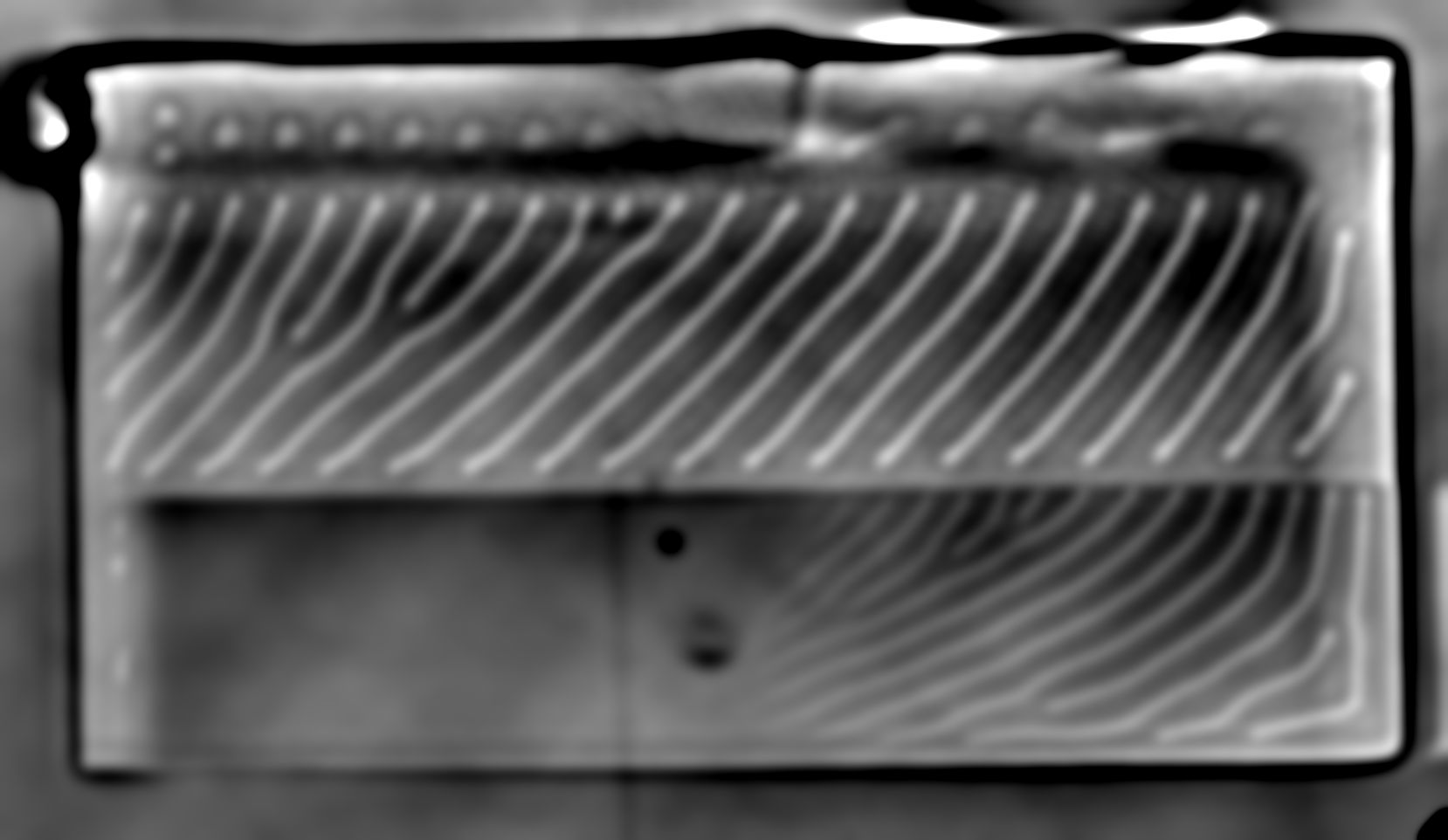
This real-space ptychographic phase image of magnetic textures measured at an external magnetic field perpendicular to the sample. It shows a stripe pattern and skyrmions (in the very top part of the sample). © HZB
Two side-by-side diagrams with colored line patterns: on the left, horizontal red-and-blue stripes with a blue arrow pointing to the right; on the right, diagonal yellow-and-red lines with a blue arrow pointing down and to the left
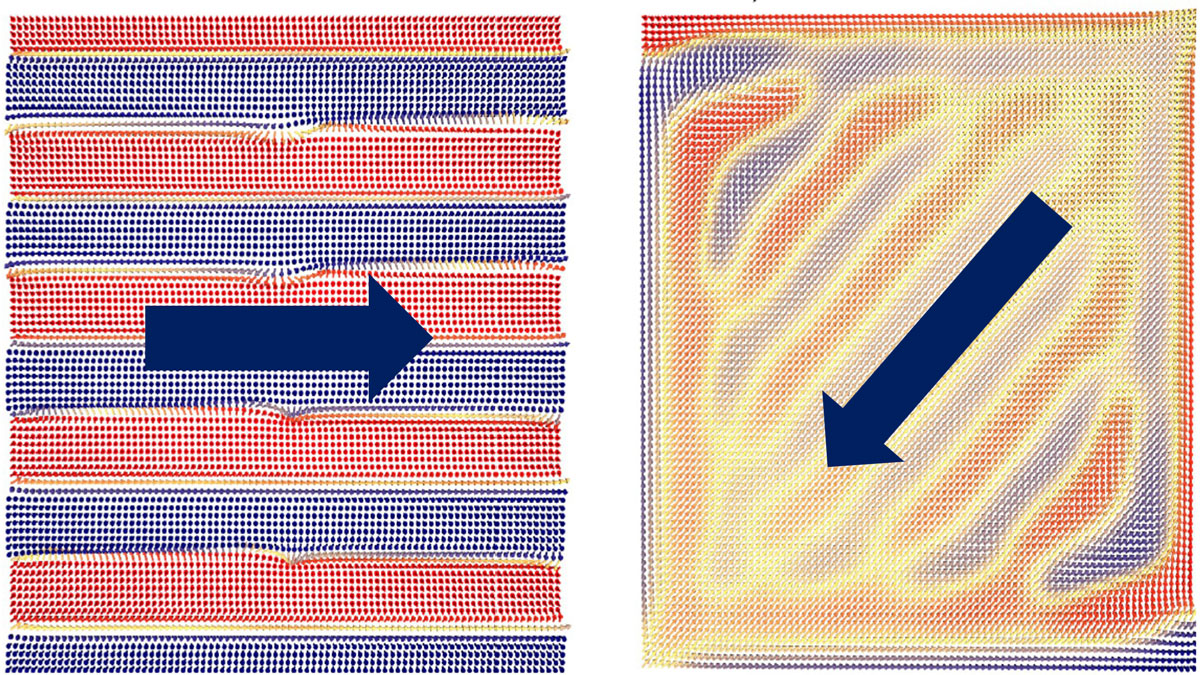
Micromagnetic simulations show how a small magnetic field in plane with the magnetic stripes can change the magnetic texture from a stripe pattern to a fan pattern © HZB

(Fe0.63Ni0.3Pd0.07)3P or FNPP is a magnetic material that exhibits complex magnetic structures even at room temperature. This makes the material of interest for spintronics, a field that could enable data processing with significantly lower energy consumption. One potential application is novel magnetic memory devices. However, generating and modifying the desired structures in a controlled manner remains a challenge to date. A new study led by HZB has now taken a step forward in this regard. They demonstrated at the worldwide unique VEKMAG-Station at BESSY II, that a tiny external B-field in the plane of the magnetic patterns is sufficient to change them.

The team led by Dr Florin Radu investigated FNPP samples using soft X-rays and ptychography at BESSY II. The experiments aimed to map the magnetic textures whilst the sample was exposed to an external magnetic field in specific spatial directions. For this purpose, BESSY II is equipped with a globally unique instrument developed by Radu’s team themselves: the VEKMAG vector magnet can generate a magnetic field of up to 1 T in all three spatial directions.

“We observed that the magnetic stripe domains can be controlled by an external magnetic field when applied parallel to these patterns, rather than perpendicular” says Dr Victor Ukleev, first author of the study. “The surprising thing was that even a very small field of just 10 millitesla was sufficient to transform a chiral stripe configuration into an achiral fan configuration.”

Modelling provides a good explanation for this behaviour. Within the FNPP, different magnetic interactions compete with one another, resulting in complex magnetic textures. While one of these interactions is rather isotropic, another key interaction is anisotropic, with a direction of preference. "Due to our experimental observations, and thanks to collaboration with our partners, we could now identify the mechanism and understand how a weak in-plane B-field establishes an equilibrium between these interactions, thereby altering the stripe state," says Ukleev.

The FNPP material is therefore suitable as a model system for externally controlling spin textures. The results obtained here advance the development of functional magnetic materials for spintronics.

Advanced Functional Materials (2026): Vector-field control and emergent basal-plane anisotropy of magnetic textures in noncentrosymmetric (Fe0.63Ni0.3Pd0.07)3P
V. Ukleev, O. I. Utesov, L. Ubilla, C. Luo, R. Abrudan, P. Wild, H. Kropf, M. Winter, S. Schneider, A. Tahn, B. Rellinghaus, T. Butcher, S. Finizio, S. Wintz, M. Weigand, M. Birch, Y. Tokura, Y. Taguchi, K. Karube und Florin Radu
DOI: 10.1002/adfm.77809


Contact:

Dr. Victor Ukleev
Helmholtz-Zentrum Berlin für Materialien und Energie
Abteilung Spin und Topologie in Quantenmaterialien
victor.ukleev(at)helmholtz-berlin.de

Dr. Florin Radu
Helmholtz-Zentrum Berlin für Materialien und Energie
florin.radu(at)helmholtz-berlin.de

Dr. Antonia Rötger
Helmholtz-Zentrum Berlin für Materialien und Energie
Pressestelle
(030) 8062-43733
antonia.roetger(at)helmholtz-berlin.de


HZB Press Release dated September 7, 2026.

Research Photonics / Optics

Related News

Microscopic images with scale bars ranging from 10 micrometres to 500 nanometres

New insights into quantum materials using magnetic imaging

Micro-flowers increase the local magnetic field and expand the range of applications for photoemission electron microscopy
Table with various optical components mounted on it

Real-time analysis of magnetic bilayer systems at BESSY II

Femtoslicing enables ‘snapshots’ of the magnetic state of materials
Spectroscopy result: homogeneous, net-like structures

Element cobalt exhibits surprising properties

Investigations of the ferromagnet at BESSY II open up prospects for its use in future spin-based information technologies
Dr. Hebatalla Elnaggar

Helmholtz Investigator Group on magnons

Dr Hebatalla Elnaggar wants to create the foundations for a new extremely efficient information technology
Illustration of the material's crystal structure

YSGAG: A Breakthrough Substrate for Quantum Magnonics from IKZ

New material allows quantum experiments at low temperatures

Related Institutions

  • Helmholtz-Zentrum Berlin für Materialien und Energie GmbH, Elektronenspeicherring BESSY II

Share this page

  • © WISTA Management GmbH
  • Legal Notice
  • Privacy Policy
  • Digital Accessibility
  • Contact
  • Career
  • Press
  • Social Media Guide
Member of:
Zukunftsorte Berlin Logo